Showing posts with label Kazakhstan. Show all posts

Page F30 reader poll on changing Kazakhstan's name

Tuesday, May 13, 2014

The poll ended a while ago and I'm taking it down now so here are the results for posterity. Kazakhstan has won against the proposed Kazak Yeli with a convincing yet not entirely overwhelming 60%.

Since the poll went up I haven't seen any more news on the issue so it doesn't look to be too high a priority for Nazarbayev to float this name change in the media and get the idea circulating.

PRESIDENT NAZARBAYEV IS FLOATING THE IDEA OF CHANGING KAZAKHSTAN'S NAME. WHICH DO YOU PREFER?

Kazakhstan (current name) 96 (60%)

Kazak Yeli (proposed new name) 62 (39%)

Nombre de votes jusqu'à présent : 158
Sondage terminé

Read more...

New poll: Kazakhstan or Kazak Yeli?

Monday, February 10, 2014

A new poll has just been added to the sidebar on the right, the first in 5 months. Kazakhstan's president Nazarbayev has begun floating the idea of changing the name of the country to Kazak Yeli (land/place of the Kazakhs), so basically a substitution of a Turkic suffix for the current Persian one. In Persian -estân means place of, and not just countries. Gol (flower) for example becomes golestân to mean flower bed (lit. place of flower). Two other suffixes, not proposed, would be Kazakhia (Latin), and Kazakhland (Germanic). The Latin Wikipedia seems to have an endless number of ways to write the country.

(Redirectum de Casachia)
Kazachstania[2] (-ae, f.) sive Kasachstania[3] vel Kazakhstania[4] vel Kasakstania[5] atque Kazachia[6]

Read more...

Chris Hadfield in Kazakhstan speaking Russian with a robe, lute and doll

Wednesday, May 15, 2013

Chris Hadfield is back safe on Earth and this video is exactly what the title says it is:


It's dubbed so the Russian can't always be made out but he sounds fluent. Not sure if it's functionally fluent, near-native fluent or completely fluent.

Read more...

Link roundup for 8 February 2012

Thursday, February 09, 2012

Today's links are:

--- This National Geographic article on Astana, the new capital of Kazakhstan. While I assume I would still prefer Almaty for its larger size and better climate, if this happens then I would consider living in Astana for a time:

With the core of the capital near completion, Nazarbayev has ordered his architects to explore the possibility of building another huge tent that would shelter a climate-controlled "indoor city" of 15,000 people.
I've always thought controlling a city's climate makes sense, and doing so would not necessarily require a perfect 20C temperature every day. Massive forestation for windy cities is one easy example of how a climate can be moderated, and simply connecting more areas through underground tunnels is an easy way to 'paraterraform' parts of them. There are quite a few examples of subway stations that are connected by underground malls, for example.

--- If you speak Portuguese and want to test your knowledge of Spanish false cognates, see here: http://noticias.terra.com.br/educacao/quiz/teste-seus-conhecimentos-sobre-falsos-cognatos-em-espanhol

--- The Bulgarian Wikipedia is having a "one new article a day" campaign from 1 to 15 March:
„1 нова статия“ — между 1 и 15 март 2012 г. ще се проведе инициативата „1 нова статия“. Целта на проекта е с общи усилия, в рамките на две седмици, Българската Уикипедия да се разшири значително. Начинът, по който това ще стане, е като всеки, който посети БГ Уикипедията между 1 и 15 март, напише по една нова статия. За повече информация и все още липсващи статии в Българската Уикипедия, посетете страницата на инициативата.
The gist of the campaign is this: if you visit the Bulgarian Wikipedia between those dates, please write a new page. The current number of articles is 126,000+, and shouldn't be too different in three weeks.

--- Barack Obama is returning $200,000 of campaign donations, a practice that, while well-intentioned, I wish politicians of all stripes would do away with. Passively receiving donations and soliciting donations are two different things, and a politician who campaigns on Position A should not be made to feel that they have to return donations from anyone who believes in Position B, has committed a crime, or anything else. Once money has switched hands it is the person who receives the donation who may now use it as he or she sees fit. If a politician does not believe in the views of someone they have received a donation from, why give it back so that they can make use of it again? Keep it and use it for good.

--- Vladimir Putin wrote an editorial for the Washington Post today about democracy.

--- Quebec solidaire sees French as a central priority, but not their primary one.

Read more...

Kazakh now spoken by 70% of the population, government plans to increase this to 95% by 2020

Wednesday, July 28, 2010

An article here in Turkish today approves of plans within Kazakhstan to increase the number of people that speak Kazakh, no surprise given that Kazakh is also a Turkic language and extremely easy for Turks to learn.

The Kazakhstan Minister of Culture Muhtar Kul-Muhammed said that 95% of the population in Kazakhstan would speak Kazakh by 2020. Muhtar Kul-Muhammed made a presentation at a government meeting called the 'Kazakh Development Plan 2011-2020' which aims to have some courses offered in Kazakh at every university.

He also said that Kazakh would also have to be taught at kindergartens and foreign language schools. At the moment 70% of the population is capable of speaking in Kazakh whereas 90% know Russian. Bakan Kul-Muhammed said that "Of course I'm not claiming that everyone throughout the country will be able to talk in Kazakh to a certain extent, but we will do our best."

President Nursultan Nazarbayev has also ordered that starting in 2010 all films to be shown in theatres with subtitles must have them in Kazakh. According to the Kazakhistan constitution the Kazakh language is the national language, and Russian remains an official language.
In actual numbers, increasing that number from 70% to 95% and allowing for population growth (1.2% per year, thus an extra 2 million over a decade) would mean an extra six million speakers of Kazakh over a decade, so from 11 million or so to about 17 million. Plus another 100,000 or so Kazakhs in Bayan-Ölgii in Mongolia, of course.

Read more...

Jonathan Aitken's biography of Kazakhstan president Nursultan Nazarbayev translated into Turkish

Sunday, July 04, 2010

Back in 2008 it was announced that Jonathan Aitken would be writing a biography on Nursultan Nazarbayev, the president of Kazakhstan. Apparently since then it has been published, and according to this article it has also been translated into Turkish. 301 pages in length, the Turkish title is "Kazakistan'ın Efsane Lideri Nazarbayev" (Nazarbayev, the legendary leader of Kazakhstan) and begins with his childhood in the Altay Mountains, eventually getting to a large part about him after being elected as Kazakhstan's first president. The article also says that this is Jonathan Aitken's 12th biography of a political leader.

Read more...

Belarus to also be included in Russian - Kazakh customs union starting 1 July 2010

Sunday, June 06, 2010

From here in Turkish. Here's part of the article:

Belarus will also be included in the full customs union between Russia and Kazakhstan slated to start on 1 July 2010.

Belarus' Economic Minister Nikolay Snopkov said that they would sign the agreements on the customs codes that were to go into effect on 1 July. Of the CIS states formed after the fall of the Soviet Union, Kyrgyzstan, Tajikistan and Moldova have also expressed an interest.

Snopkov said in a statement that Belarus President Aleksander Lukashenko and Russian First Deputy Prime Minister Igor Shuvalov had compromised on controversial issues, which include customs duties on foreign cars and airplanes.

According to Russian Economic Minister Elvira Nabuillina, trade volume between Russia and Belarus in 2009 had dropped by 31 percent, but had increased by 17 percent during the first quarter of 2010, and that half of Belarusian exports were to Russia.

Read more...

25 May 2010: Turkish President Abdullah Gul in Kazakhstan

Tuesday, May 25, 2010

Turkish President Abdullah Gül is in Kazakhstan today and the two leaders of their respective companies opened a few new buildings at Ahmet Yesevi University. This article has some information worth translating on these two Turkic-speaking countries, so here it is.

Kazakhstan President Nursultan Nazarbayev said that "Turkey and Kazakhstan are brothers with a single origin" at a press conference, after welcoming President Abdullah Gül to the presidential palace.

Regarding the opening of the new departments of Hoca Ahmet Yesevi University, Nazarbayev said "We opened the new department of this university together. This is an important university, opened under the initiative of Kazakhstan and Turkey, where over 20,000 students study. Here we have not only Kazakh and Turkish students, but students from over 20 Turkic countries as well."

(Note: that doesn't mean 20 independent countries, but both countries and autonomous regions such as Gagauzia, Tatarstan, etc.)

Nazarbayev mentioned that trade between the two countries had dropped slightly as a result of the worldwide economic crisis, but said that "In spite of these negatives we have a trade volume of 3 billion dollars between Turkey and Kazakhstan, which we hope to increase to 10 billion."

(No mention of the time frame for this)

Nazarbayev said that the businesspeople that had come to Kazakhstan with President Abdullah Gül had signed $300 million worth of short-term economic protocols, and that "These negotiations will end up with a total value of $1 billion, which is the most concrete benefit of this visit."


The university mentioned in the article is this one, the home page of which is in Turkish, Kazakh, English, and Russian.

Read more...

Drying of the Aral Sea called a "shocking disaster" by UN's Ban Ki-moon

Monday, April 05, 2010

Remember this post from a few days ago on Lake Urmia in Iran? I noted that at least the drying there wasn't as severe as that found in the Aral Sea, which has seen some pretty drastic drying over the past decades.


Just a few days later, the UN's Ban Ki-moon is due visiting Uzbekistan where he has toured the Aral by helicopter and called the drying of the lake (a total of 90% of its original volume) a "shocking disaster".

Turkey's TRT has a few images here of the area from yesterday.

Read more...

Lake Urmia in Iran is slowly drying up; gathering on the 3rd of April to raise awareness

Thursday, April 01, 2010

On Balatarin today I noticed a link going to the following image:


Urmu Gölü quruyor (kuruyor in Turkish) is Azeri for "Lake Urmia is drying up", and the rest of the poster says that there will be a gathering on the 3rd of April. Doing a bit more searching turned up this Facebook group, and a notice that a gathering in Ankara will take place on the 3rd in front of the Azerbaijan Cultural Association (Azerbaycan Kültür Derneği) to raise awareness.

The lake itself is located here in northwestern Iran where all the Azeris live:


View Larger Map

At least the lake isn't on the border between two countries like the Aral Sea is:


View Larger Map

What you see there used to be a single lake:

Due to being located between Kazakhstan and Uzbekistan it may have made it easy to blame the other side and ignore one's own responsibility (because why should we reduce our water consumption when the other side uses it as much as they want? - as the argument goes) over the past decades, whereas Lake Urmia is located entirely within Iran and its fate depends solely on the actions of a single nation. A gif here shows Lake Urmia over a similar period of time, and though there's definite drying it's thankfully not nearly as drastic as the Aral Sea.

Read more...

Random links for 25 February 2010

Thursday, February 25, 2010

Firefox has too many tabs open at the moment with articles and links that are worth a mention but perhaps not their own post, so here they are in no particular order.

A review of a new dictionary of Old English, which so far has been completed up to the letter G (out of a total of 22 letters) and expects to have between 33,000 and 35,000 headwords. There are a few interesting etymological notes there as well, such as the origin of the word baleful.

New Scientist on symbols on cave paintings that appear to be a real code or language, not just random scribblings. Apparently studies of cave paintings have been so distracted by the imagery itself for so long that nobody really thought to check the tiny scribblings next to the drawings. See here and here to take a look at the actual symbols and their frequency for yourself.

Also remember that simply tracing languages back to their source doesn't necessarily help us discover the origin of language, because for all we know there was, or were other languages that preceded the ancestor of all the ones we speak and simply died out. This talk mentions that a bit:


Washington Post has an article today on Kazakhstan and uranium. I mentioned back in 2008 that Kazakhstan was set to become the world's largest producer of uranium in a year, and now it is.

Times Online has a fascinating piece today on a British PoW who snuck into Auschwitz during WWII.

Miles O'Brien on why he supports the White House's new plans for NASA.

Phobos flyby season is beginning again, and the ESA's Mars Express will have a particularly close encounter (just 50 km above the surface) on the 5th of March.

An article here is on the partnership between the EU and Russia on space technology. The Russian Soyuz rocket will launch from Guiana for the first time this year.

Finally, here's an optical illusion along with instructions on how to make your own.

Read more...

Kazakhstan to make religious education mandatory

Thursday, August 20, 2009

Here's something I'm sure many have overlooked, an article in Turkish from last week on a recent vote in the parliament in Kazakhstan to make religious education mandatory.

The National Ministry of Education in Kazakhstan has made religious classes in the country mandatory in upcoming years, after a past where atheism during the period of Soviet rule had become almost a national ideology in the country. A spokesperson from the ministry said that "Religious education which had been optional till now will become mandatory from the upcoming year in schools. We believe that the creation of religious tolerance among children during their early years will be helpful."

The majority of the population in Kazakhstan is Muslim, and the Christian minority is almost entirely Russian Orthodox. Kazakhstan has a population of about 16 million, with 65% Muslim, 30% Christian, and 5% other. The country's official language is Kazakh, with Russian as the second official language. Kazakhstan has a presidential system, does not have a state religion, and according to its 1995 constitution is a secular state where ethnic groups are equal in the eyes of the state.

Kazakhstan has also recently banned the drinking of alcohol in open areas.

Read more...

Azerbaijan, Kazakhstan and Turkmenistan aren't really landlocked countries

Wednesday, July 29, 2009

Kind of a random subject but worth thinking about if you haven't before. At the moment the world has 44 landlocked countries, as you can see in this map.

Landlocked simply means that a country doesn't border an ocean, and in that sense it's technically correct for Azerbaijan, Kazakhstan and Turkmenistan. In practice though, a landlocked country usually implies all the disadvantages that come from a lack of access to the sea, meaning the inability to create a maritime industry, difficulties in international trade, etc. Countries like Switzerland, Liechstenstein, Nepal and Bhutan are clearly landlocked and have to work within those confines. Azerbaijan and the other two though are quite different, for two reasons.

The first is obvious: they do have access to a sea - the Caspian Sea. Technically it's the world's largest lake, but in terms of size, historical status and use it's a sea. It's a bit of a microcosm of an ocean in that it provides access to other countries as well, even if it's just four (the three mentioned above plus Russia and Iran).

Thanks to the access to the sea, these technically landlocked nations are able to have a thriving maritime industry and culture. It has a lot of caviar, oil, fish, etc. In terms of transport as well it's quite useful as it is the quickest way to go from Azerbaijan to Turkmenistan (both energy-producing countries), and there is quite a bit of ferry traffic as well. So these landlocked nations certainly aren't suffering there.

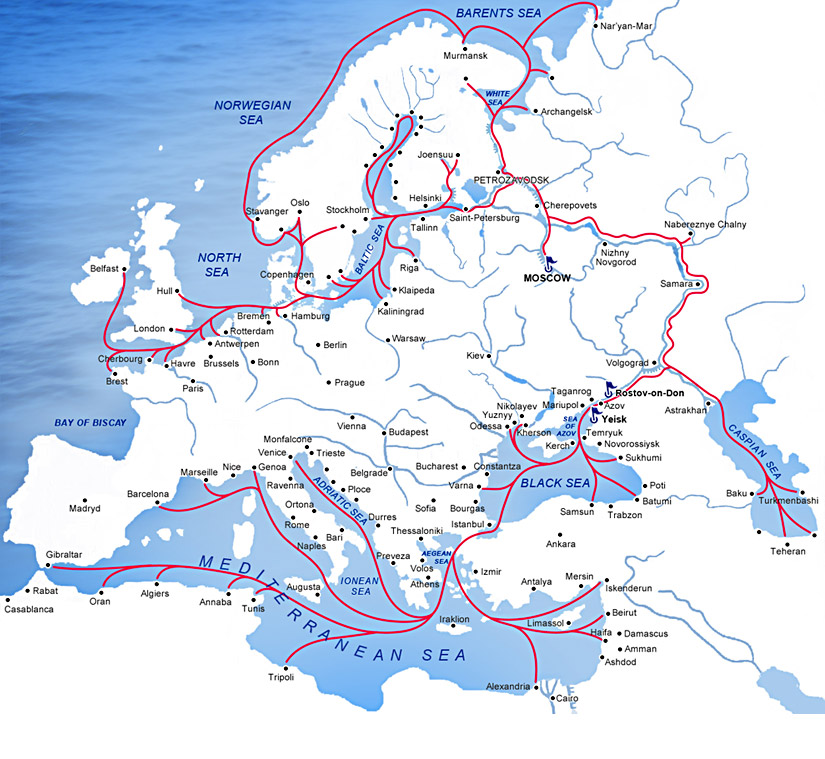
The second reason is a bit less obvious: those three nations actually do have access to the sea, by going through Russia. Note the Volga River there as it flows into the Caspian from the northwest. It's actually connected to the Don River, which flows into the Sea of Azov, which is connected to the Black Sea, which is connected to the Mediterranean, which is connected to the Atlantic...

Ships of up to 5,000 tons capacity can pass through the canal connecting the two rivers, which means ships even a bit larger than this one. Not too shabby.

Having direct access to the sea in this way is not only helpful in trade, but also in international relations, as could be seen last year in the war within Georgia over South Ossetia, when a number of nations sent ships into the Black Sea to help out one side or the other. I don't remember any ships being sent from the Caspian Sea there, but it's technically a possibility, so a ship docked at the Caspian Sea technically could set sail and make its way to the Black Sea or beyond.

You can see a map here from a company that trades in the area that shows how you get from the Caspian into the larger seas and oceans to the west.

Out of the three nations though, Azerbaijan is certainly the one that feels the most maritime. Kazakhstan's capital and largest city lie way off to the east. Turkmenistan feels a little less isolated from the water with its smaller size and a capital much closer to the sea than Astana. Azerbaijan, though, has its capital and largest city (Baku) right on the Caspian, and has an economy largely centred on the oil that comes from the Caspian. Since Azerbaijan wouldn't be Azerbaijan without the Caspian Sea, it feels a bit weird to call it a landlocked country when a country like the Democratic Republic of Congo isn't landlocked simply for having a tiny strip of land that borders on the ocean.

There's no need to redo the definition of a landlocked country, it's simply worth bearing in mind that these "landlocked" countries can vary immensely.

Read more...

Kazakhstan to launch its second satellite in 2011 / Kazakistan ikinci uydusunu 2001'de fırlatacak

Saturday, March 14, 2009

KazSat-1Жер айналымында тұрақты жайғасымында (103° E) орнатылған Қазақстанның алғашқы ғарыш жабдығы ( Jer aýnalımında turaqtı jaýğasımında (103° E) ornatılğan Qazaqstannıñ alğaşqı ğarış jabdığı.)


Here's most of an article from here (haberler.com) on Kazakhstan's second satellite that it plans to launch in 2011.

Kazakhstan to launch its second satellite in 2011 / Kazakistan ikinci uydusunu 2001'de fırlatacak

Kazakistan, yeni uydusu Kazsat-2'yi 2011'de fırlatacak. Kazak basınında yer alan haberde geçtiğimiz yıl ilk uydusu "Kazsat-1" ile bağlantıyı yitiren Kazakistan'ın yeni uydu Kazsat-2'yi 2011'de fırlatacağı bildirildi.
Kazakhstan will launch its second satellite Kazsat-2 (ҚазСат-2) in 2011. Kazakh media said in a news broadcast that Kazakhstan, which had lost contact with its first satellite Kazsat-1 last year, would send up its new satellite Kazsat-2 in 2011.
18 Haziran 2006'de Kazakistan'daki Baykonur uzay üssünden fırlatılan "Kazsat-1" uydusu yaklaşık 100 milyon dolara mal olmuştu. İki yıl faaliyet gösteren 12 yıl ömürlü Kazsat-1 uydusuyla Aralık 2008 itibariyle bağlantı kesilmiş ve daha sonra uydunun resmen devre dışı kaldığı ilan edilmişti.
The Kazsat-1 satellite, sent up on 18 June 2006 from Kazakstan's Baykonur Cosmodrome, cost about 100 million dollars. Kazsat-1 was to have a life of 12 years but only had 2 years of activity, lost contact in December 2008 and has remained out of touch since then.
Kazakistan Ulusal Uzay Ajansı'ndan yapılan açıklamada bu yıl zarfında ayrıca "Kazsat-3" uydusu için de fizibilite çalışmalarının başlatılacağı ve bu çalışmaların 2011'e kadar tamamlanacağı kaydedildi.
The Kazakhstan National Space Agency said in a statement that Kazstan-3 would commence feasability work within this year, and that this would be completed by 2011.
"Kazsat-2" uydusunun maliyeti konusunda ise herhangi bir bilgi verilmedi.
No data has been given as to the cost of the Kazsat-2 satellite.

Read more...

A bit on South Korea and the Korean diaspora in Kazakhstan

Tuesday, March 10, 2009

I just remembered these two pictures that I took back in 2007 that involved gathering books to send to overseas Koreans in Kazakhstan; the sign was placed at the edge of a park (I'll show the location below after the pictures) and looked like this:


Here's what it means:

  • 카자흐스탄 거주교포들에게 우리민족의 마음을 보냅시다 <-- Let's send our heart to our people living in Kazakhstan

  • 해외동포를 위한 도서기증 운동에 참여하세요 <-- Please participate in the book donation for overseas Koreans

  • 기증기간 : 2007.01.10 ~ 2007.02.28 <-- Donation period 기증장소: 강남구립국제교육원1층 또는 각동사무소 <-- Donation area: Gangnam-gu International Education Centre 1F, or offices per neighborhood (dong, smaller than a gu)
  • 기증대상: 도서 (헌책, 새책 불문 / 그림책부터 전문서적까지 전종류 <-- Donation items: books (new or second hand / all types from picture books to specialized publications)

  • 주최: (사) 해외동포책보내기운동협의회 <-- Sponsor: Book-sending council for overseas Koreans
  • 후원: 강남구, 재외동포재단, 주한카자흐스탄대사관, 매일경제사 <-- Support: Gangnam-gu, Overseas Koreans Foundation, Embassy of Kazakhstan in Korea, Maeil Business (newspaper)
  • 문의: (사) 해외동포책보내기운동협의회 [Tel 02) 3442 - 1937] <-- Contact: Book-sending council for overseas Koreans

I have no idea how successful this drive for book donations was. The website for the Embassy of Kazakhstan is also a bit odd as it's written in English and Korean alone. Where's the Kazakh and Russian?

As for the location of the sign, it was right here:


View Larger Map

That's a park called Seonjeongneung (선정릉) where a few ancient kings are buried and nowadays people either pay 1000 won (now worth *less* than a dollar) to enter, or just walk around on the path encircling the park to get some exercise where the air is much better. The poster is on one of the fences at the edge of the park, and you can see the green walking path on the right side. Living near this park is highly recommended for anyone thinking of living in Seoul. It could make the difference between black lungs and healthy pink ones.

The best part about the park is this part:


View Larger Map

because it's still relatively small compared to your average North American city park, but right in this area is a small part where all of a sudden you can't see the city around you in any direction, which is something extremely hard to find within the city.

The Korean Wikipedia gives the following information on the numbers of overseas Koreans (Goryeoin, 고려인) in Central Asia:

중앙아시아의 고려인은 대부분 우즈베키스탄카자흐스탄에 거주한다. 카자흐스탄의 고려인 문화는 이전의 수도였던 알마티(Almaty)를 중심으로 하는데, 이 곳에서는 중앙아시아에서는 유일하게 한국어 신문(고려 신문)과 한국어 극장이 운영된다. 카자흐스탄의 인구조사에서는 1939년 96,500명의 고려인이 기록되었고, 1959년에는 74,000명, 1970년에는 81,600명, 1989년에는 100,700명, 1999년에는 99,700명이었다.

우즈베키스탄의 고려인들은 농촌 지역에 넓게 흩어져 있다.

Translation: Most overseas Koreans in Central Asia live in Uzbekistan and Kazakhstan. The centre for Goryeoin culture in Kazakhstan is centred in the former capital of Almaty, and here is run the only Korean-language newspaper (Goryeo Shinmun) and Korean-language theatre in Central Asia. According to census data from Kazakhstan there were 96,500 Goryeoin in 1939, 74,000 in 1959, 81,600 in 1970, 100,700 in 1989, and 99,700 in 1999.

The Goryeoin in Uzbekistan are scattered about widely through the rural (agricultural) area.

Read more...

Horses were domesticated about 1,000 years earlier than previously believed

Saturday, March 07, 2009

The Ishim River, a river fed by the tributary Iman-Burluk River where the Botai culture was located.

Olivier sent me the link to this piece of news yesterday:
Medieval knights, the warriors of Saladin, Roy Rogers and fans lining racetracks around the world all owe a debt to the Botai culture, residents of Central Asia who domesticated horses more than 5,000 years ago.

New evidence corralled in Kazakhstan indicates the Botai culture used horses as beasts of burden — and as a source of meat and milk — about 1,000 years earlier than had been widely believed, according to the team led by Alan Outram of England's University of Exeter.

"This is significant because it changes our understanding of how these early societies developed," Outram said.

Domestication of the horse was an immense breakthrough — bringing horsepower to communications, transportation, farming and warfare.
Not only is this important for archaeological and historical purposes, but also political ones. Kazakhstan is very interested in becoming closer with Europe as this article in Turkish from three days ago states:
Nitekim Kazakistan, Avrupa ile bütünleşmek için demokratikleşme yönünde önemli adımlar atmaya başlamıştır. Kazakistan, 2030 yılına kadar ekonomik ve sosyal rekabet gücü en gelişmiş olan ülkeler arasına girmeyi amaçlamıştır. Bu nedenle, Kazakistan Parlamentosu ‘Kazakistan-2030 Stratejisi’ni gerçekleştirmiştir.
Kazakhstan has begun to take important steps concerning democratization to integrate itself with Europe. Kazakhstan plans to be one of the most developed nations in economic and social competitive ability by 2030, for which the Kazakhstan Parliament has carried out a 'Kazakhstan-2030 Strategy'.

and:
Kazakistan, 2010 AGİT Dönem Başkanlığı’na hazırlanıyor. Avrupa Birliği, Kazakistan’ın AGİT başkanlığı adaylığını destek ederek Kazakistan ile işbirliği isteğini göstermiştir. Kazakistan, Orta Asya sorunlarına dikkat çekerek Orta Asya Bölgesi’nde güvenlik, istikrarlaşma ve demokratikleşmenin sağlanmasında önemli rol oynayabilecektir.
Kazakhstan is preparing itself for its 2010 presidency of the OSCE (Organization for Security and Cooperation in Europe). The European Union has shown its desire for cooperation with Kazakhstan in its support for Kazakhstan's presidency of the OSCE. Kazakhstan will be able to play an important role in providing security, stabilization and democratization in the Central Asia region while drawing attention to the issues there.

...so Kazakhstan is probably happy about this important discovery that shows it to be a central location of original Indo-European culture.

Back to the original article: it reminds me of this post I wrote quite some time ago which contains this quote from the book The Languages of the World:
It would appear that the Indo-Europeans lived in a cold northern region; that it was not near the water, but among forests; that they raised such domestic animals as the sheep, the dog, the cow, and the horse; that among wild animals they knew the bear and the wolf; and that among metals they probably knew only copper. Many believe that it was the use of the horse and chariot that enabled them to overrun such an enormous expanse of territory.
Finally, one more quote from the article that explains the significance:

"It is not so much the domestication of the horse that is important, but the invention of horseback riding," commented anthropologist David W. Anthony of Hartwick College in Oneonta, N.Y. "When people began to ride, it revolutionized human transport."

"For the first time the Eurasian steppes, formerly a hostile ecological barrier to humans, became a corridor of communication across Eurasia linking China to Europe and the Near East. Riding also forever changed warfare. Boundaries were changed, new trading partners were acquired, new alliances became possible, and resources that had been beyond reach became reachable," observed Anthony, who was not part of Outram's research team.

Some researchers believe this new mobility may have led to the spread of Indo-European languages and many other common aspects of human culture, Outram said.

Read more...

Uzbek part of Turkmenistan-China natural gas pipeline to be completed in 2010 / Türkmen-Çin doğal gaz boru hattının Özbekistan etabı 2010'da bitecek

Tuesday, February 17, 2009

Source: zaman.com.tr (Turkish)

First take a look at this image of the region:
You can see that the way to get natural gas from Turkmenistan (the country on the southwest part of the highlighted countries on the map) to China requires going through two other countries. You could technically go all the way through Kazakhstan but that's much too indirect, and technically Afghanistan is joined with China but the country is unstable and the piece of land connecting the two is extremely thin...plus it's way too mountainous, which includes Tajikistan and Kyrgyzstan. That means that going through Uzbekistan and Kazakhstan is really the only logical route.

With that said, let's take a look at the article:

Türkmen-Çin doğal gaz boru hattının Özbekistan etabının 2010 başında faaliyete geçmesi bekleniyor. Boru döşemesinin 2009 itibariyle biteceği hatta, asıl gaz sevkiyatının 2010 Ocak itibariyle yapılması planlanıyor.
The Uzbek part of the Turkmenistan-China natural gas pipeline is expected to start activity at the beginning of 2010. The laying of the pipe will be finished as of 2009, and actual gas shipments are planned to happen in 2010.

Türkmenistan gazını Çin'e taşıyacak boru hattının Özbekistan etabını, Özbekistan-Çin ortaklı 'Asia Trans Gas' şirketi yapıyor. Hattın 525 km'lik Özbekistan etabının yaklaşık 3 milyar (2 milyar 975 milyon) dolara mal olması bekleniyor.

The part of the pipeline to transport Turkmen gas to China located in Uzbekistan is being carried out by the joint Chinese-Uzbek 'Asia Trans Gas' company. The 525 km long part in Uzbekistan is expected to cost $2.975 billion.

The pipeline is around 7000 km in length, of which 185 km is in Turkmenistan, 525 km is in Uzbekistan, 1,293 km in Kazakhstan and 4,860 km of which goes through China. The part in Uzbekistan goes through the provinces of Buhara-Kashkadarya and Navoiy, which you can see here in red:

Finally:

Türkmenistan'ı Çin'e bağlayacak olan boru hattında yılda 30 ile 40 milyar metreküp arasında değişen miktarlarda doğal gaz sevkıyatı yapılabilecek.

The pipeline between Turkmenistan and China will be able to transport varying volumes of natural gas between 30 and 40 billion cubic metres per year.

Read more...

Railway cargo between China and Kazakhstan: 12.6 million tons / Çin ve Kazakistan arasında demiryoluyla taşınan kargo miktarı: 12.6 milyon ton

Tuesday, December 30, 2008


Source: turkish.cri.cn (Turkish)

Çin ve Kazakistan arasında demiryoluyla taşınan kargo miktarı: 12.6 milyon ton
Railways cargo volume carried between China and Kazakhstan: 12.6 million tons
Kazakistan Devlet Demiryolu Şirketi tarafından bugün (27 Aralık) yapılan açıklamaya göre, bu yıl Kazakistan ve Çin arasındaki Dostyk-Alatao sınır kapısından geçen demiryoluyla taşınan kargo miktarının 12 milyon 600 bin tona ulaşması bekleniyor.
According to an announcement today (27 December) by the Kazakhstan State Railway Company, the amount of cargo between Kazakhstan and China that passed through the Dostyk (Достық)-Alatao border area reached 12.6 million tons.
Kazakistan Devlet Demiryolu Şirketi, iki ülkenin demiryolu birimlerinin ortak çabaları sayesinde demiryoluyla taşınan kargo miktarının yıldan yıla arttığını, bu yıl Çin'den Kazakistan'a gönderilen kargo miktarının 6 milyon 150 bin tonu geçerek, 2007 yılına göre 1 milyon 100 bin ton arttığını kaydetti.
The Kazakhstan State Railway Company said that thanks to combined efforts by railway entities in the two countries the amount of cargo transported by rail increased year by year, and that this year the amount of cargo from China to Kazakhstan surpassed 6.15 million tons, an increase of 1.1 million tons from 2007.

Read more...

Kazakhs to start messaging each other in the Kazakh language too

Saturday, December 13, 2008


From the Kazakh Wikipedia: Уикипедияға, Қазақша Ашық Энциклопедиясына, қош келдіңіз! <-- My rough half-Turkish romanization: Uikipediya'gha, Kazaksha ashik entsiklopedyasina, khosh keldiniz! Real Kazakh romanization: Wïkïpedïyağa, Qazaqşa Aşıq Éncïklopedïyasına, qoş keldiñiz! Standard Turkish equivalent would be: Vikipedi'ye, Kazakça açık ansiklopedisine, hoş geldiniz! (Welcome to Wikipedia, the Kazakh-language open encyclopedia)


Source: dunyabulteni.net

Short summary:

Starting next year, cell phone operators in Kazakhstan are going to have a Kazakh-language SMS service, which will be the first time this has happened. This is due to a new law that services related to society must be provided in the Kazakh language as well. Right now there are four telephone operators active in the country, and up to now messaging has generally been in Russian. Kazakhstan has a population of 16 million and 15 million cell phone subscribers.

Read more...

Kazakhs much more assertive at promoting their own language

Wednesday, December 10, 2008

Қазақстан (Қазақстан Республикасы) — Еуразия құрылығының қақ ортасында орналасқан мемлекет.

Here are two articles on the subject from November and also from last week.

Quoth the first article:

U.S. oil group Chevron, developing Kazakhstan's biggest oil deposit, said on Friday it had received a note from the authorities accusing it of neglecting Kazakh as a language of business communication.

The accusation is part of a broader trend in the resource-rich nation to revive Kazakh -- a Turkic language spoken in most parts of Central Asia -- as a symbol of the country's independence from Moscow's rule.

Chevron said it disagreed with the assertion.

"(We) developed a Kazakh language plan many years ago and we are proud to say that a significant portion of our most critical business is done in all three languages," Chevron's local unit said in a statement written in English, Russian and Kazakh.

I'd be curious what the view of the authorities would be of a company (but not a Turkish company) attempting to use Turkish as a means of communication - whether it would be welcomed as another Turkic language, or whether it would be even more offensive in possibly coming across as assuming Kazakh to be a dialect instead of an independent language.

And from the second:
Whereas government documents were once produced in Russian only, now they are written in both languages.

Officials have had to take lessons in Kazakh, while in schools the hours spent teaching the language have increased.

“I was speaking Russian and my teacher said, ‘Why are you speaking this? Where’s your honour?’” said Almas Moldakozha, 18, an ethnic Kazakh student in Almaty, the country’s largest city and former capital. His experience reflects how sensitive a subject language is in a country where many were forced to learn Russian during the Soviet era.

The efforts to promote Kazakh are part of the Strategy Kazakhstan 2030, devised by the country’s president, Nursultan Nazarbayev. The aim is for Kazakhstan, helped by its Caspian Sea oil wealth, to turn itself into a developed country where Kazakh, Russian and English are widely spoken by 2030.
I remember reading a blog this year written by a guy in the Peace Corps who is spending a year (or years, can't remember) in Kazakhstan, and as he's white people are constantly surprised that he only speaks English and Kazakh, and keep on trying to talk to him in Russian even though he can't understand a word of it. I would be pretty much in the same boat there if I had to make a trip in the near future.

Read more...

  © Blogger templates Newspaper by Ourblogtemplates.com 2008

Back to TOP