First impressions of Michael Ignatieff as Liberal leader

Saturday, February 28, 2009


I have to admit I'm more impressed with Ignatieff than I thought I would be. So far he seems to be doing a good job as leader of the party, and here's why:

1) Grumbling within the party has virtually disappeared. It always surfaced now and then with Dion but Ignatieff seems to be much better at keeping the party united. The party probably has Dion to thank for this, actually, as without his disastrous leadership there wouldn't have been so much of a desire for anybody to replace him, and given that Ignatieff almost won the leadership during the last convention anyway while Dion kind of snuck in due to voting rules and a desire for a moderate leader, there were quite a few within the party that never really regarded him as the legitimate leader in the first place.
2) Ignatieff seems to know how to speak to the West. This seems to be his international experience showing itself, as he doesn't come across as a person that favours one region over another, and with that favoratism usually comes blame (real or implied), which is what can drive a lot of people to vote for the other party. This article is one of many that I've seen over the past few days on speeches he's given in the West, and he seems to understand the importance of energy in that part of the country and doesn't want to do anything to alienate the region. Here's what he said today:

The trip west was Ignatieff's second in as many weeks. With an eye on the next election, Ignatieff is trying to distance himself as a leader from his party's historic failings in the region.

"God knows this party has made mistakes out in the Western Canada and I know them," Ignatieff said in Regina several weeks ago.

He also had words for former Liberal leader Stephane Dion's Green Shift plan, which was nearly as unpopular in the west as Pierre Trudeau's national energy program.

"I think you can't win elections if you are adding to the input costs of a farmer . . . or a trucker," Ignatieff said in a news conference in Edmonton Friday. "You got to work with the grain of Canadians and not against them."

"I think we learned a lesson in the last election."

But Ignatieff emphasized the Liberals are not backtracking on the environment agenda.

"Our goal is very simple -- to reduce the amount of energy input into everything we do," he said.


I wrote yesterday that Ignatieff might be able to win the next election without having to exert all that much effort, if the country doesn't see him as trying to grab power (as was the case with the coalition) and if the country gets a bit bored with Harper. I think the overall impression of the political situation right now is that 1) The Conservatives aren't the most beloved party at the moment but they won the election as a minority so let them continue to govern for the time being; 2) If the Liberals show signs that they've learned from their past election defeats then they'll probably be given another chance.

What will probably be Ignatieff's greatest challenge in the next election (whenever it is) will be keeping the so-called troops in line. Voters don't like melodrama in their politicians, and if it looks like Liberal Party candidates are too eagerly chomping at the bit or too inclined to try to demonize the Conservative Party as opposed to presenting their own vision for the country, they'll be punished again. Ignatieff is probably going to have to draft up a list of things for candidates not to say, such as don't try to make comparisons to George Bush and the Conservatives anymore (Bush is long gone and those comparisons don't work anyway), don't call them neo-cons or fascists, don't call them racist, don't say anything that makes it look like you are taking votes for granted, and so on.

Oh, and for Ignatieff himself: no mentioning Barack Obama too much. Though they apparently have a number of mutual friends, people don't really appreciate trying to ride on another person's coattails. I think Ignatieff's smart enough to avoid this though.

Read more...

International Turkish Television (Uluslararası Türkçe TV) to begin broadcasting on the 21st of March

Turkic languages spoken throughout the world. The dark blue indicates countries where it is spoken as an official language; lighter blue shows regions located within other countries.

Well, this is interesting:
Türkçe konuşan ülkeler arasında ilişkileri geliştirmeyi amaçlayan Uluslararası Türkçe TV 21 Mart'ta yayına başlayacak. 24 saat yayın yapacak olan televizyonda her bir ülkeye 4'er saat yayın hakkı tanınacak.
International Turkish Television, aiming to deepen relations between Turkish-speaking nations, will begin broadcasting on the 21st of March. The television to be broadcast 24 hours a day will give 4 hours of broadcasting to each nation.

Let's see, so those six would be Turkey - Azerbaijan - Turkmenistan - Uzbekistan - Kazakhstan - Kyrgyzstan. So how does it work?

Azerbaycan Türkçesinin Türkiye'de anlaşıldığını belirten Şahin, bu nedenle Azerice yayınların olduğu gibi yayımlanacağını, diğer ülkelerin programlarının ise Türkiye Türkçesine tercüme edilerek, alt yazıyla yayına verileceğini belirtti.
(General manager) Şahin said that Azeri Turkish is comprehensible to those in Turkey and thus would be broadcast as is, and that programs for other nations would be translated into Turkish (Istanbul Turkish, that is) with subtitles below.


Though not the language of independent nations, note that some other Turkic languages are easier to understand even than Azeri Turkish (IMO) such as Gagauz, spoken in the south of Moldova (Gagauz Yeri). I have an easy time reading just about anything in Gagauz whereas Azeri still trips me up a fair amount.

Also, don't forget that Uyghur and Uzbek are also very similar (apparently like Turkish and Azeri), which makes the four hours broadcast in Uzbek accessible to those living in Western China as well.

Read more...

Latin Wikipedia: Page on Charles Darwin (Carolus Robertus Darwin); William (Gulielmus) Wordsworth to appear as page of the month for March instead


The page of the month for February on the Latin Wikipedia was Azerbaijan (Adrabigania), and now that February is almost over it's time for the next one to be selected. Originally it was supposed to be Charles (Carolus) Darwin, but as you can see here the page is certainly not ready to be featured, and instead Willian (Gulielmus) Wordsworth will probably be selected instead: you can see his page in its current state here.

It even includes a sample of his poetry with a Latin translation:

My heart leaps up when I behold Exsilit cor cum cernam
A rainbow in the sky: arcum in aethere:
So was it when my life began, sic fecit, ut primum vixi,
So is it now I am a man, sic facit dum homo sum,
So be it when I shall grow old, sic faciat cum senescam,
Or let me die! aut moriar!
The child is father of the man: Puer patrem patrat:
And I could wish my days to be et mihi velim dies esse
Bound each to each by natural piety. innatá inter se religione vinctos.

You can see the comments on the page of the month here, such as this one:
People are making useful changes in Gulielmus Wordsworth, and if that means it's going to be the pagina mensis for March, that's fine with me, as we can postpone Darwin till next February or later. The main respect in which the French & Italian wikis' versions differ from ours is that they offer critical commentary about Wordwsworth's art, after the account of his life. (Ours may be the only wiki that mentions the epigraph from the Appendix Vergiliana and observes its significance.) Strangely, the English version doesn't have such commentary. If somebody would like to translate a few such paragraphs from the French or the Italian, please feel free to have a go! IacobusAmor 14:34, 27 Februarii 2009 (UTC)

And a sample from the article:

Prima publicatio et Lyrical Ballads

In praefatio ad Lyrical Ballads, considerata declaratio iudicii litterati Romanticismi Anglici, Wordsworth sua poemata "pro experimento" (Anglice: experimental) appellavit. Anno 1793, edidit eius primas poematum congeries: An Evening Walk et Descriptive Sketches. In Somersetia eodem anno, in Samuel Taylor Coleridge incidit, et poetae cito facti sunt amicissimi. Interea, anno 1795, Raisley Calvert, poetae amicus, qui nocte 9 Ianuarii–10 Ianuarii 1795 obiit, anno aetatis suae vicesimo primo, legatum argenti £900 pondo ei legavit ut continuet scribere poemata. Anno 1797, Wordsworth et Dorothea soror ad Domum Alfoxton in Somersetia migraverunt, perpauca milia passuum a domo Coleridge in vico Nether Stowey.

Communiter, Wordsworth et Coleridge, cum Dorotheae consilio, mox produxerunt Lyrical Ballads (1798), principale Romanticismi Anglici opus. Liber nec nomen Wordsworth nec nomen Coleridge detexit. Unum ex Wordsworth inclutissimorum poematum, "Tintern Abbey," est in eo divulgatum, una cum "The Rime of the Ancient Mariner," carmine a Coleridge scriptum. Mirabiliter, secunda libri editio, anno 1800 edita, solum Wordsworth scriptorem nominavit, et explicationis continuit praefationem, magnopere in editione anni 1802 auctam, quae nunc habetur grave theoriae litterarum artificium. In ea, Wordsworth disserit de rebus quae in iudicio suo sunt elementa novi generis poiesis, in "sincero hominum sermone" constituti—generis quod floridam plurimorum saeculi poematum dictionem defugit. Hic adseverat Wordsworth pervulgatam poiesis definitionem: "spontaneus sensuum validorum aestus ex animi motibus in memoriam tranquille reductis." Quarta ultimaque Lyrical Ballads editio anno 1805 edita est.

Read more...

Small robots could prepare Lunar surface for later manned missions

Latin Wikipedia needs more info on the Moon; this is just about all of it: "Luna (-ae, f.) satelles naturalis Terrae est. Astrum, quod ab hominibus visitatum sit, unicum est. Nam duodecim ad coelum viatores Civitatum Foederatarum Americae in campis lunae ambulaverunt ."

Interesting article here on some of the finer details involved in operating a manned outpost on the Moon. One problem is as follows:

1) Rocket takeoffs and landings need to be fairly close to the outpost in order to make it easy to move things and people back and forth, but
2) The Moon has no atmosphere and not that much gravity, so any rocket takeoff or landing would result in a huge amount of dust being blown around, effectively sandblasting the outpost, so
3) There needs to be either some sort of barrier around the rocket launching pad, or the launching pad needs to be constructed so as to remove as much dust as possible.

It turns out that robots will be able to do this construction, which is a really big plus.
The research examined two potential solutions: 1) construction of a berm around the landing site, and 2) creation of a hard-surface landing pad using indigenous materials.

In the first solution, researchers found that two rovers weighing 150 kilograms each would take less than six months to build a berm around a landing site to block the sandblasting effect. A berm 2.6 m tall in a 50-metre semi-circle would require moving 1.2 million kilograms of lunar dirt. Robots this size can be sent to NASA's planned polar outpost site in advance of human expeditions. Astrobotic Technology Inc. has proposed that landing site preparation be provided by commercial ventures.

In the second solution, researchers showed how small robots could comb the lunar soil for rocks, gathering them to pave a durable grit-free landing pad, said John Kohut, Astrobotic's chief executive officer. "This might reduce the need to build protective berms. To discern the best approach, early robotic scouting missions need to gather on-site information about the soil's cohesion levels and whether rocks and gravel of the right size can be found at the site."
One thing not mentioned in the article is that this is only possible on the Moon thanks to its location, some 1.3 light seconds away from us, which makes operating the robots from the surface possible. If the destination were Mars the robots would have to have a much more independent guidance system, or we would have to wait about 10 minutes or more at a time as commands are sent to the robot, the robot carries out the command, the signal comes back to Earth, and then we can finally decide what to tell it to do next. To the Moon and back would be more like the delay you often see in places like CNN with interviews with overseas correspondents; not too bad overall. Once again there's no comparison when it comes to location.

Read more...

Number of stars in the visible universe: 30 billion trillion

Neil deGrasse Tyson being awesome.


When talking about the subject of life and civilizations on other planets in other star systems there's something called the Fermi paradox that basically says that "if there is so much life in the universe, why hasn't any of it contacted us?" -- that if there really is life in other star systems we should have some sign of them such as radio signals.

Well, the first thing to mention is that there is a huge difference between simply having life and having a civilization that can produce radio signals. On Earth it took a huge amount of time (a few billion years) to get everything "just right" to produce us, and until then there were periods of hundreds of millions of years of animals dominating the planet, then going extinct, then new types springing up, then disappearing, and finally we appeared, and the first commercial radio broadcasts in the US only began in the 1920s, so it really hasn't been all that long for us. If you were to spin a Wheel of Fortune-type wheel where each 100-year period since the beginning of the Earth had one cm of space (so that there was a chance of you being able to land your finger on it as you stopped it, the wheel itself would have a diameter of 143 kilometres. If you only went from when life began on Earth, it would have a diameter of 117 kilometres. The area since the dawn of history (let's say 10000 years or so) would be a metre long. Chances are, if you're taking a snapshot of Earth during its existence it would have life, but no civilization, and even if you landed on a point with civilization, chances are it wouldn't have anything close to a radio.

Plus!

There's also the fact that the universe is just big. A great site (which is actually the subject of the post) is this one here, atlasoftheuniverse.com. It's not flashy at all but there's a part of the site that gives you a great idea of just how big the universe is (start here and click once to zoom out each time), and once you start seeing that we are just a speck on the arm of a very normal galaxy and that there are actually clouds and superclouds of galaxies out there, it becomes very easy to see why it wouldn't be all that easy to contact us. Indeed, by the time you get out to a distance of a mere 250 light-years you've already covered one third of the stars we can see in the sky with the naked eye.

Like Neil deGrass Tyson, I find this idea exhilarating, not the least bit depressing.


Finally, there's a classic video here:


that also gives a good idea about the size of the universe as you take off from Chicago and move out into space. What's most interesting is the journey back, because every time you decrease the ratio by a factor of ten you've made it 90% of the way back from that scale (that is, if you're 10,000 km away then the first 9,000 km is 90% of the first distance, then the next 900 km is 90% of the remaining distance, the next 90 km is 90% of that remaining distance and so on), but it still takes a near eternity to get back.

Read more...

A brief history of violence: the world is currently at its most peaceful point in history.

I mention this fact quite a bit during discussions on forums online when I see someone wailing and gnashing teeth about the current state of the world, because on the whole the current state of the world is quite good and continues to improve. There's a video on this subject as well from 2007:


Along with this there is also a continued increase in literacy in the world:

Poverty continues to decrease everywhere but Sub-Saharan Africa:

and life expectancy continues to increase (once again Sub-Saharan Africa is the unfortunate exception):

I'm pretty sure I wrote pretty much the same post last summer but it deserves to be repeated again, because it's a pretty important point that helps us keep things in perspective. At the moment there are two major things to take care of that will change the world pretty substantially for the better: continuing development in China and India (because of their humongous populations) and finding a way to improve the situation in Sub-Saharan Africa (this is the hard part). Apparently kiva.org (a system whereby one can give out small loans to entrepreneurs in the poorest parts of the world) is a good way to help.

Read more...

February 27, February 28 2009: Venus and crescent Moon extremely close after sunset

Friday, February 27, 2009

Just a reminder that this will be the last opportunity to see Venus and the Moon right next to each other in the evening for quite some time, as right now the Moon is below Venus and tomorrow (or today depending on where you live in the world) it'll pass by and above and soon be farther up in the sky away from Venus. Now Venus is beginning to sink down so by next month it'll be close to the Sun and out of view, so after that the Moon and Venus will only be next to each other in the morning later on, and if you're not a morning person either you know how tough that is to wake up to see.

Read more...

Battle over stimulus money could force an election


...in Canada. The Globe and Mail reports:

Prime Minister Stephen Harper is demanding MPs let his government bypass normal approval processes for $3-billion of stimulus spending, saying it's imperative to rush aid as the economy falters, and warning he's willing to head to another election should opposition parties block it.

The Tories are proposing the fund's cash be spent over 90 days between April 1 and June 30 and want to take shortcuts in allocating it – although they promise to report back afterward on its disbursement. Under normal procedures, money wouldn't have started flowing until June.

Liberal Finance critic John McCallum called the fund a “blank cheque” and his NDP counterpart Thomas Mulcair likened it to a “slush fund” – a charge that made Mr. Harper bristle yesterday while talking to reporters in Vancouver.

The Prime Minister said opposition MPs have “a job to do” now and that's to approve the funds, especially because they urged the Tories to move quickly on stimulus.

That last part is why the Prime Minister is so confident in saying that he's willing to go to an election again over this issue, because last December 1st opposition parties (Liberals, Bloc Quebecois, NDP) formed a coalition in order to supplant the government and make then-leader Stephane Dion the next prime minister...but the reason given for the coalition was:

It includes a "policy accord" to address the "present economic crisis," which states that the accord "is built on a foundation of fiscal responsibility."

An economic stimulus package will be the new government's top priority, while other policies include a commitment to improve child benefits and childcare "as finances permit."

Indeed, the official name of the accord launching the coalition was "An Accord on a Cooperative Government to Address the Present Economic Crisis". Their second document (here, pdf) stressed the need for a stimulus package now, that the Canadian economy couldn't wait and that it needed to be done as soon as possible. The document said:

Economic Stimulus Package

The top priority of the new Government is an economic stimulus package
designed to boost the domestic economy beginning with...

and:

Rapid Support for those affected by the Economic Crisis

The new Government is committed to ensuring that the federal government has the appropriate programs in place to assist those most affected by the economic crisis so that all citizens will be in a position to fully participate in the economic recovery to follow, including the following measures...

and on top of that, the Liberal Party voted with the current budget (with a bit of a limp-wristed warning to withdraw support if they choose later on), so if all of a sudden the opposition decided to vote against this rapid release of stimulus money they would be put on the uncomfortable footing of explaining why:

1) (Liberals and NDP): they were so adamant about getting stimulus money out right now last year but all of a sudden aren't a fan, and

2) (Liberals only) in addition to this, why they voted for the budget and then all of a sudden have decided to oppose getting the money out quickly.


The only defence against this would be that the Conservative Party's priorities are wrong and that they're doling out the money in the wrong way, but that isn't really a platform you can run on in an election -- "Yes we voted for the budget and where the money was to be allotted but we think it's worth going to an election because we don't think they're distributing it as well as we could" <-- a pretty blah platform to run on considering that elections cost quite a bit of money in the first place.

One way they could win, though, is if Canadians are just sick of the current situation and viscerally decide that Ignatieff is the person to bring about change. I suppose an election could be won on a kind of ephemeral "this just isn't working, elect us and you'll get something different and awesome"-type platform. It would have to be done just right though to avoid backlash.

Read more...

Michael Steele = Poochie


Watching Michael Steele in action is simply fascinating. This guy seems to be exactly what some Democrats feared Obama might be like (and never turned out to be), a guy that seems to be trying way too hard to try to change the packaging on the party, and not so interested in actually presenting a coherent platform that one can feel comfortable voting for. I think during the nomination process in 2008 what Democrats were most afraid of when considering supporting Obama was the thought of nominating a dud that would turn out to be all flash and no substance, so watching Steele in action is kind of like watching an alternate universe where Barack Obama was actually the candidate that everyone feared he might be. Just take a look at some of his recent statements. Here's one:

RNC chair Michael Steele says he is "open to that baby" when it comes to supporting primary challengers against the three GOP senators who voted in favor of the stimulus package.

"Oh, yes, I'm always open to everything, baby, absolutely" Steele said yesterday on Fox News' 'Your World with Neil Cavuto'.
another:
“We want to convey that the modern-day GOP looks like the conservative party that stands on principles. But we want to apply them to urban-surburban hip-hop settings.”

He added, jokingly, that “we need to uptick our image with everyone, including one-armed midgets...I don't do 'cutting-edge,’” he said. “That's what Democrats are doing. We're going beyond cutting-edge.”
Uptick the image with one-armed midgets - that's beyond cutting-edge!

and another one today:
“Tonight, we tell America: we know the past, we know we did wrong. My bad. But we go forward in appreciation of the values that brought us to this point.”
even Michelle Bachman is getting into the spirit:

As Steele concluded his remarks, Minnesota Rep. Michele Bachmann — the event's moderator — told Steele he was “da man.”

“Michael Steele! You be da man! You be da man,” she said.

Michael Steele seemed a lot like something I had seen on tv before, and then I realized what it was - Michael Steele is Poochie from the Simpsons. In case you're one of the few people that doesn't watch Simpsons, Poochie was a character created for one episode when executives decided that Itchy and Scratchy needed some pizazz, and that the way to do that would be with a rapping dog with sunglasses and a surfboard. Needless to say, his appearance didn't do anything for the show's popularity, everybody hated the new character and they got rid of him as soon as possible. Here's the audio of him making his first appearance:


(BTW let me know if you're able to upload a video showing the actual Poochie in action during this scene and I'll change it)

Michael Steele is trying way too hard to be cool, before even working on a reason for people to even vote GOP in the next election. I'm reminded of a great quote from last year by Andrew Sullivan where he wrote:
Some readers seem to think my description of Obama as boring is meant as a criticism. Subjectively, maybe it doesn't give me a Lowry. But objectively, it's brilliant. The first black president will only get there by boring a lot of white people. And haven't we had enough drama in the last eight years? Boring is fucking awesome after Bush.
This is true with everybody - all people want a bit of boring out of their politicians. Unplanned coolness here and there is great of course ("Barack Obama is a fan of The Wire?" "Hey, he collects comic books!" "He uses a Blackberry all the time!" etc.), but people want to discover this on their own, and they don't want to see a kind of unholy meshing of politics and individual coolness. If Barack Obama had run as a super cool "I-understand-young-people-'cos-I-like-The-Wire-and-comic-books-and-technology-y'all" candidate he would have lost. The situation at the moment is too serious and people just aren't in the mood for games.


Edit: Stephen Colbert seems to be thinking much the same thing (except for the actual reference to Poochie). Here's a video from the Colbert Report today:


Edit a few hours later: wow, I just did a search for Michael Steele Poochie and it looks like I'm not the first to notice the connection - here, here, and here. Looks like a few other people have noticed the similarity.

Read more...

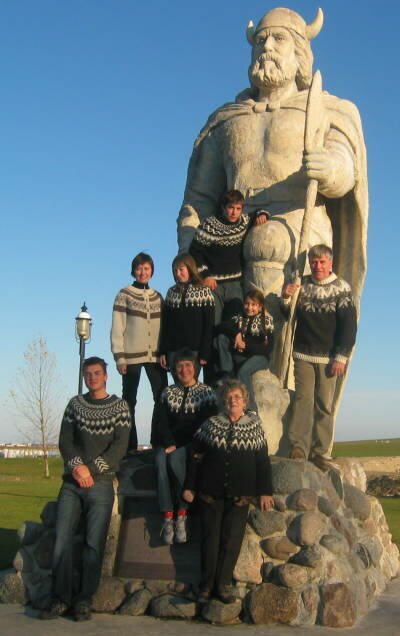
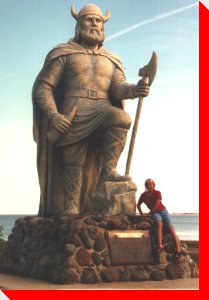
Vikings striking the "look at me, I'm awesome" pose

A post here today had me thinking: just how many of those "look at me, I'm awesome" Viking statues are there in the world? Has anybody documented their total number? Here are a few:

Leif Ericson being awesome in front of Hallgrímskirkja

Probably Leif Ericson near the Minnesota State Capitol

Leif Ericson being awesome on a stamp in 1968
Rollo the Viking, founder of the fiefdom of Normandy


Adding to that this guy here and here (Eric the Red I think) in Canada and a ton of other images seen here when you search for viking statue, and it seems that there are quite a few of these out there. Perhaps thousands. I'd like to see an entire museum devoted to these statues and images around the world. Perhaps one day in the future I'll think about setting one up in the Icelandic village of Markerville in Alberta, close to Red Deer. Certainly would bring in a lot more tourists than the creamery. Or perhaps just going with Gimli as a location would be a better idea.

Read more...

French language gaining ground among adults in Mayotte / Le français gagne du terrain chez les adultes de Mayotte

Mayotte, an overseas collectivity of France, is located here, close to Madagascar:

and it's apparently one of the overseas territories where the French languages is least well-known:

French is the only official language of Mayotte. It is the language used by the administrations and the school system. It is the language most used by televisions and radios as well as in commercial announcements and billboards. In spite of this, Mayotte is one of the French overseas territories where the knowledge of French is the least developed, as shown by the figures above. At the 2002 census, only 55% of people older than 15 y/o declared they could read and write French, although this figure is higher than those who can read and write Shimaore (41%) or Arabic (33%).
In addition to that, Mayotte has one of the highest rates of population growth among the overseas territories with an annual increase of 5.8%:
Quant au taux d'accroissement annuel de la population, il est l'un des plus forts de l'outre-mer français avec 5,8 ‰.
and:

1958 1966 1978 1985 1991 1997 2002 2007
23,364 32,607 47,246 67,205 94,410 131,320 160,265 186,452
Official figures from past censuses.

which makes it a pretty obvious choice for the government to focus its efforts on, as 1) It's already an overseas territory, 2) The population is growing rapidly, 3) There's no other strong competitor there that French would need to compete with (English or Spanish for example).

On that note, there's an article in French here from yesterday on the apparent successes the government is having in getting people to learn French:

Depuis maintenant 2 ans, le Greta organise régulièrement des sessions d'examen du Dilf, le diplôme initial de langue française, qui permet d'avérer un premier niveau de français à des personnes reconnues non francophones. Le Dilf atteste d'un niveau de compréhension et d'expression orale qui permet de s'en sortir dans le contexte professionnel, socio-économique et de la vie quotidienne.
For two years now, Greta (a group of establishments for public education) has regularly organized test sessions for Dilf, the original diploma of the French language, which allows non-Francophones to prove their French speaking ability. The Dilf demonstrates a level of comprehension and oral expression that helps one in professional and socio-economic contexts, and in daily life.
Avec la mise en place de nombreuses "écoles des parents" dans les différents établissements scolaires de l'île, les candidats au fameux diplôme se multiplient, et en 2008 des sessions d'examen ont eu lieu en mai, juin, juillet, octobre et décembre, dépassant avec succès les 90% de réussite.
With the establishment of many "schools for parents" in various school establishments in the island, the candidates of the well-known diploma have multiplied, and in 2008 exam sessions were held in May, June, July, October and December, with a success rate of 90% for those taking it.*

Wikipedia also has the following on the recent success of French in Mayotte:

With the mandatory schooling of children and the economic development both implemented by the French central state, the French language has progressed significantly on Mayotte in recent years. The survey conducted by the Ministry of National Education showed that while first and second language speakers of French represented 56.9% of the population in general, this figure was only 37.7% for the parents of CM2 pupils, but reached 97.0% for the CM2 pupils themselves (whose age is between 10 and 14 in general).

Already there are instances of families speaking only French to their children in the hope of helping their social advancement. With French schooling and French language television, many young people turn to French or use many French words when speaking Shimaore and Kibushi, leading some to fear that these native languages of Mayotte could either disappear or become some sort of French-based creole.


Read more...

Why it's worth it to study Dutch

Thursday, February 26, 2009


The Dutch-speaking world (including related languages like Afrikaans and regions where it is spoken by a minority).


I just noticed that Berkeley has an interesting page here with testaments by students that have studied the language on why it was worth it to do so, with quite a few of them remarking on how much easier the language turned out to be than expected. I've written before that I believe Norwegian to be the easiest language for English people to learn, but this is only in comparison to other languages, and Dutch, Afrikaans, and the other Scandinavian languages are still much easier to master than a lot of other languages out there.

One person on the page writes:
Dutch is an interesting and remarkably simple language. I took Dutch to satisfy breadth requirements and also because I wanted to learn a European language. I was intimidated the first day I went to class, as we began to learn/speak Dutch ten minutes into the class. But after a few classes I realized Dutch is easy. Many words are phonetically similar or the same as in English, and the conjugations of verbs are rather simple. I also learned Spanish, but Dutch is much easier!
and another one writes:
So, if you’re wondering, “are there any Dutch people around,” you might be surprised by the numbers: Dutch is spoken by nearly 40 million people worldwide. In California alone, nearly half a million people responded to the US Census saying they have Dutch ancestry. In fact, more than twenty-seven thousand Californians speak Dutch at home...Dutch may be the easiest language for English speakers to learn. With simple grammar rules and the same alphabet, you’ll be reading, writing and speaking in Dutch faster than any other language. Make it easy on yourself to meet the language requirement.

The strategy that a student needs to adopt when learning languages like these is pretty much the same for each one, because:

1) They are relatively easy to learn, but
2) That means that English is also very easy for them to learn, and so:

that means that as a student of the language you are probably going to need one of two things:

1) A lot of motivation to get really good at the language through listening to and using it online (where nobody knows you're not Dutch at first; you can even pretend to be from somewhere like Kazakhstan or Iran to make sure people don't switch to English right away when chatting), or
2) A structured university course for a number of years before you go abroad, because in the beginning it's only in a situation like that where you'll be able to practice the language without the person you're talking to becoming exasperated and switching to English.

There are also some interesting hidden benefits, like the similarity to Afrikaans and the large amount of Dutch loanwords in Indonesian:
People can sometimes use Dutch to get by in unexpected places. One of those places is Indonesia. Some older Indonesians still speak Dutch, but even the younger generation is interested in the language. University students, for example law students, are often required to study Dutch texts. Many universities in Indonesia therefore offer courses in Dutch as a source or occupational language. Students and other interested parties can enrol in general Dutch courses at various educational centres, the most important of which is the Erasmus Language Centre (ETC) in Jakarta. Each year, some 1500 to 2000 students take Dutch courses there.
Plus making German much easier to learn of course.

Read more...

Stimulus package already bringing about changes


It's interesting to watch some of the concrete changes taking place now that the stimulus package has been approved. One of them is shown here on the Washington Post, whereby transit users have their monthly benefit doubled starting Sunday, which apparently makes transit free for most.
Good news for transit riders: Starting Sunday, the monthly transit benefit allowance increases to $230 from the current $120, thanks to the recently enacted economic stimulus package.

The new federal legislation allows employers to subsidize their employees as much as $230 a month, or $2,760 a year, in public transportation benefits. Or an employee can receive the benefit as a pretax payroll deduction or some combination of the two.
Here's who benefits the most:
The benefit could boost ridership among commuters who have the longest and most expensive rides, officials said. On VRE, about 65 percent of commuter rail riders are federal employees who receive the free monthly transit subsidy. A $230 monthly subsidy would pay for a rider's entire commute on the Manassas line and all but $40 for Fredericksburg line riders traveling the farthest distances, said VRE Chief Executive Dale Zehner. A monthly pass between Manassas and Union Station costs $220.90; the monthly pass between Fredericksburg and L'Enfant Plaza costs $270.

What I'd like to see though is an article on the effect this has on those facing foreclosures or struggling with rent (because I know pretty much nothing about the Washington D.C. area). This article says that:

RealtyTrac, which collects foreclosure data, recently reported that foreclosure activity in January was 18 percent higher than in January 2008.

"We feel extremely sorry for the people who have to go through the [foreclosure] process," said Thomas R. Kunz, president and chief executive officer of Century 21 Real Estate. He attributed much of the downward pressure on prices to the huge inventory of homes for sale, many of which are foreclosed properties.

Maybe I'll email Nate Silver to see if he'd be interested in whipping up a quick analysis on the benefits of increased funding in public transportation for those struggling with paying off huge mortgages.

Read more...

Latin now has its own iPod / iPhone app with proverbs and sayings

Latin got a bit of friendly press two days ago with this article about an app for the iPhone / iPod that gives people the ability to stay in touch with the language, something quite hard to do after studying it in school but then finding little use for it in the workplace and in daily life. Here's one example:

Quaedum iura non scripta sed omnibus scriptis certiora sunt - Some laws are unwritten but they are better established than all written ones.

I suspect someone will come along and mention Schola on ning.com so I'll beat them to the punch: schola.ning.com is another good place to practice Latin online, as well as the forums on Nuntii Latini.

Read more...

The real list of Wikipedias


The main list of Wikipedias in all languages can be seen here. This list automatically sorts the various Wikipedias by number of articles, after first dividing them into 1) over a million 2) over 100,000 3) over 10,000 4) over 1,000, and so on. Thanks to the Volapük Wikipedia though it's been shown that the true worth of a Wikipedia does not always come from the number of articles, but often from the number of edits. One reason for this is that different Wikipedias have different criteria for what makes an article, and a lot of them will merge several related pages into one large page where another Wikipedia will prefer them to be split up into smaller ones. First of all, here's the list according to article count for those above 100,000:

(ignoring English which is at #1 with a few bazillion articles)

Language Language (local) Articles
2 German Deutsch 871,777
3 French Français 771,020
4 Polish Polski 582,772
5 Japanese 日本語 565,807
6 Italian Italiano 544,834
7 Dutch Nederlands 521,965
8 Portuguese Português 462,176
9 Spanish Español 448,483
10 Russian Русский 363,562
11 Swedish Svenska 307,663
12 Chinese 中文 235,558
13 Norwegian (Bokmål) Norsk (Bokmål) 209,082
14 Finnish Suomi 195,145
15 Catalan Català 161,975
16 Ukrainian Українська 139,193
17 Turkish Türkçe 124,946
18 Romanian Română 121,754
19 Czech Čeština 120,387
20 Hungarian Magyar 119,588
21 Volapük Volapük 118,759
22 Esperanto Esperanto 111,257
23 Slovak Slovenčina 105,729
24 Danish Dansk 103,774
25 Indonesian Bahasa Indonesia 100,349


In some cases this is accurate with German and French being at the top, some other fairly large languages in the middle and languages with a speaking population of around 10 million somewhere above 100,000. However, some Wikipedias there have an extraordinarily high number of edits compared to their article size (Spanish) while some are extremely low (Volapük). Here's what the list looks like compared to the number of edits:

Language Language (local) Edits
2 German Deutsch 59,249,161
3 French Français 40,855,127
9 Spanish Español 25,862,703
5 Japanese 日本語 25,047,937
6 Italian Italiano 24,525,940
4 Polish Polski 16,838,187
7 Dutch Nederlands 16,133,979
10 Russian Русский 14,495,738
8 Portuguese Português 14,484,935
12 Chinese 中文 9,500,869
11 Swedish Svenska 8,757,938
14 Finnish Suomi 6,474,549
17 Turkish Türkçe 5,426,589
13 Norwegian (Bokmål) Norsk (Bokmål) 5,371,832
20 Hungarian Magyar 5,171,646
19 Czech Čeština 3,742,312
15 Catalan Català 3,385,668
24 Danish Dansk 3,004,581
18 Romanian Română 2,849,603
25 Indonesian Bahasa Indonesia 2,385,576
16 Ukrainian Українська 2,311,234
23 Slovak Slovenčina 2,159,140
22 Esperanto Esperanto 2,139,079
21 Volapük Volapük 1,745,080


All of a sudden Spanish rockets up to fourth place, and Volapük is now at the bottom.

This part of the chart only shows languages with at least 100,000 articles though, and there are actually quite a few Wikipedias under 100,000 with many more edits than the ones above, and these are:

Language Language (local) Edits
28 Hebrew עברית 6,931,960
27 Arabic العربية 3,866,850
26 Korean 한국어 3,093,020
33 Bulgarian Български 2,414,382
32 Serbian Српски / Srpski 2,269,694
35 Persian فارسی 1,969,766
30 Vietnamese Tiếng Việt 1,859,050
31 Slovenian Slovenščina 1,751,257

Hebrew really stands out here in that in terms of number of edits it's just after Swedish, which is in 11th place.

Finally, Volapük: even though the 100,000+ articles were mostly created by one person using a bot, why is the number of edits still relatively high? If the articles were uploaded once and then left alone, shouldn't the number of edits be only slightly larger than the number of articles?

That would be the case except for the presence of other interwiki bots, whose responsibility is to update links between Wikipedias of every language. That means that if you create an article on your Wikipedia and then link it to another one, eventually a bot will be along to update those links when someone in another language creates an article on the same thing. Add to that bots that update image links and a variety of other things, and you end up with quite a few edits for even the smallest of articles, none of which add any content noticeable to the reader. That's why you'll see page histories like this:

For an article that in the end only has this much text for the reader to peruse:

Alà dei Sardi binon zif in topäd: Sardegna, in Litaliyän. Alà dei Sardi topon videtü 40° 39’ N e lunetü 9° 20’ L.

Sürfat ela Alà dei Sardi binon mö 188,6 km².

Alà dei Sardi labon belödanis 1 949 (2001).


Bottom line: Spanish and Hebrew are much bigger than you might think, Volapük is not. Oh, and the Afrikaans Wikipedia is a bit of a hidden gem with a high amount of detail (here's their current featured article) in spite of still having under 12,000 articles. There are some fantastic editors over there.

Read more...

  © Blogger templates Newspaper by Ourblogtemplates.com 2008

Back to TOP