Showing posts with label Latin. Show all posts

Italy's Vivarium Novum is still doing great

Monday, October 26, 2015

I think I wrote about this program a few times a few years ago, and it seems to be doing even better than ever, reaching a level where prospective students have to be turned away now.

I found the part about the Malawi government selecting someone to attend the most interesting:
“Humanist languages are not archaeological relics,” argues Miraglia. “They’re a key to all fields of knowledge. They open up the mind. Latin is the mother tongue of our civilization and humanism is the key to peace and tolerance. The crisis of modern language is the crisis of today’s world. If you neglect your past, how can you understand the present, and most of all the future?” 
Chikondi Medson, 20, comes from a Zulu village in Malawi, where his father earned 60 cents a day. His country’s government selected him to attend the academy for his outstanding academic skills. 
“In Homer’s works I find so many rituals and values of my own community. Like when Aeneas transports the dead body of his beloved father Anchises, that part of ‘The Iliad’ really hit me,” he said. “I was moved.”

Read more...

New poll: Kazakhstan or Kazak Yeli?

Monday, February 10, 2014

A new poll has just been added to the sidebar on the right, the first in 5 months. Kazakhstan's president Nazarbayev has begun floating the idea of changing the name of the country to Kazak Yeli (land/place of the Kazakhs), so basically a substitution of a Turkic suffix for the current Persian one. In Persian -estân means place of, and not just countries. Gol (flower) for example becomes golestân to mean flower bed (lit. place of flower). Two other suffixes, not proposed, would be Kazakhia (Latin), and Kazakhland (Germanic). The Latin Wikipedia seems to have an endless number of ways to write the country.

(Redirectum de Casachia)
Kazachstania[2] (-ae, f.) sive Kasachstania[3] vel Kazakhstania[4] vel Kasakstania[5] atque Kazachia[6]

Read more...

The Latin word huswiva

Thursday, December 19, 2013

This article on the completion of a Medieval Latin dictionary (after only 100 years of effort) has an interesting note on the word housewife, which apparently made an appearance as Latin huswiva before ever being seen in English:

Some of the words of Old and Middle English that were ‘borrowed’ in the Latin language were found in earlier Latin texts than the first appearance of these words in English.

Many we still use today in a modern form, for example, the Medieval Latin huswiva corresponds to modern English housewife, found as early as 12th century Latin texts.
The word of course is Germanic, but looking at the written word alone Latin may have beat English to the chase.

Wiktionary's etymology of the word is not nearly as interesting.

Etymology
house +‎ wife

Read more...

Latin Wikipedia closing on 100,000 articles

Monday, November 25, 2013

And these are real articles, not bot-created ones. At the moment it looks like this:


The article creation rate there I think is about a hundred a day, and with the excitement of just a thousand to go it will probably reach 100,000 fairly soon. Let's guess...sometime next weekend is when I think it will happen.

Read more...

What a spoken Latin revival might look like

Monday, July 22, 2013

An article a few days ago about the Pope's Latin account and its huge following has an interesting quote:

Pope Francis' latest Latin tweet – or as Father John Zuhlsdorf has suggested, “pipatum” – reads “Domine, largire nobis gratiam plorandi indifferentem animum nostrum necnon immanitatem quae in mundo et in nobis insaeviunt.”

It is a translation of the same day's English language tweet, “Lord, grant us the grace to weep over our indifference, over the cruelty that is in the world and in ourselves.”

The rather high level of interaction with the “pipati” counters the claim that Latin is “dead,” Noone said. He noted that he and several of his colleagues can speak the language, and that other languages which had fallen into the disuse typical of Latin have actually been revived.

He noted Irish Gaelic, which was spoken by less than three percent of Irishmen in 1922, but by nearly 40 percent today; and Hebrew, which was used only by rabbis and particularly devout Orthodox Jews, but is now the national language of Israel.

He is very right about languages like Irish that are enjoying a revival, and just last week I watched a few episodes of a documentary showing what it's like to try to do things in Ireland only using Irish, no English. The star of the documentary (No Béarla) has unfortunately too much of a chip on his shoulder about the language (he constantly says that it's dead, uses far too difficult expressions with people and even rants on the street from time to time), but the reactions from the people he encounters are extremely interesting. One could imagine such encounters in a place with a high concentration of Latin speakers (imagine something like the World Congress of Esperanto), who in the beginning would not be fluent but able to communicate in varying degrees of proficiency.


Read more...

Link roundup, 29 June 2013

Sunday, June 30, 2013


Read more...

Link roundup for 19 June 2013

Thursday, June 20, 2013


  • Google Drive is now available in 18 more languages, up to a total of 65. The new ones are: Afrikaans, Amharic, Basque, Chinese (Hong Kong), Estonian, French (Canadian), Galician, Icelandic, Khmer, Lao, Malaysian, Nepali, Persian, Sinhalese, Spanish (Latin America), Swahili, Urdu, Zulu.
  • A video by the late Claude Piron discussing Esperanto in French is just as interesting for the Italian subtitles as it is for the subject matter.


  • Tim Kaine gave a speech in the Senate in Spanish about a week ago, and his Spanish is very good:


Read more...

Link roundup for 25 May 2013

Sunday, May 26, 2013

A few articles:


Finally something interesting on Wikipedia that is usually found in the less-used languages but now in the 1 million+ ones:


That's a list of the largest Wikipedias by number of articles, and going back at least to 2005 the ranking by article count has always been English, then German, and then French about 100,000 articles behind German. Over the past few weeks Dutch has all of a sudden gone from a bit over 1 million to nearly 1.6 million, leaping over French and soon to be the second-largest after English. This of course is artificial and mostly done by bots, and the number of edits, users and depth make this clear:

Edits: German 124 million, French 93 million, Dutch 38 million
Users: German 1.7 million, French 1.6 million, Dutch 0.5 million
Active users: German 20.8 thousand, French 18 thousand, Dutch 4.7 thousand
Depth: German 89, French 162, Dutch 10

So there may be some grousing soon after Dutch takes over second place in this ranking.

Below the 1 million mark the two worst offenders are: Waray-Waray and Cebuano, both with 350,000+ articles and a depth of 3 and 4. The ones with the best depth on that level: Hebrew, Arabic, Turkish, and Persian.

Read more...

Chess in Armenia, Latin interpretation, RhinoSpike

Monday, March 25, 2013

Three quick things to mention today:

-- Chess to become mandatory in schools in Armenia


-- Here's what simultaneous Latin interpretation looks like. Glad the stream I listened from didn't have this, because I was trying to follow it myself. This video has an unusually large number of thumbs down, probably a combination of anti-Catholic sentiment (though the interpreter is not necessarily Catholic or even religious) and linguistic envy.


-- RhinoSpike looks like a good place to find free audio recordings with matching text, as well as to request your own. I could see myself requesting something there later - something less common like Persian or Armenian or even European Portuguese or Occitan. Actually the transcription request looks good too.

Read more...

Latin announcement of Pope Francis

Friday, March 15, 2013

I was watching the announcement live yesterday and was pleased to hear Latin spoken for the first time in a while. My Latin not being especially good, I thought after hearing that either: 1) the Pope's name is Francisco, or 2) something to do with the Franciscan Order that I didn't understand was announced. Luckily it was the former.

I found the following on the Portuguese Wikipedia giving the Latin announcement with translation in Portuguese:

Annuntio vobis gaudium magnum:Anuncio-vos com grande alegria
habemus Papam!temos um Papa!
Eminentissimum ac Reverendissimum Dominum,O Eminentíssimo e Reverendíssimo Senhor
Dominum Georgium MariumD. Jorge Mario
Sanctæ Romanæ Ecclesiæ Cardinalem BergoglioCardeal da Santa Igreja Romana, Bergoglio
qui sibi nomen imposuit Franciscum.que adotou o nome de Francisco.

After a quick glance at some other Romance Wikipedias I don't see a translation in any of them.

Read more...

Benedict XVI's Latin is very easy to understand

Tuesday, February 12, 2013

Interesting piece here in Portuguese on the importance of Latin in the Vatican, where the Italian reporter Giovanna Chirri was the first to hear about the upcoming resignation of the Pope due to being able to understand his Latin spoken in a ceremony the previous day where he remarked that he had "important news for the future of the church, and that he was getting old".

Read more...

Habebimus novum Papam

The title and text of this post are courtesy of Olivier Simon, who has not only found the Latin text of Pope Benedict XVI's announcement today (which is the language the announcement was made in), but has also made an interlinear translation below for our benefit.


Fratres carissimi Non solum propter tres canonizationes ad hoc Consistorium vos convocavi,
Brethren dearest. Not only because-of three canonizations to this Consistory I have-summoned

sed etiam ut vobis decisionem magni momenti pro Ecclesiae vitae communicem.
but too so-that to-you (a) decision of-big importance for (the) Church’s life I-communicate

(Nota : IMO, we should have gotten the ablative “vitâ” instead of “vitae”)


Conscientia mea iterum atque iterum coram Deo explorata ad cognitionem certam perveni
By-conscience my again and again in-front-of God explored [refers to “conscience”] to knowledge sure I-have-come

vires meas ingravescente aetate non iam aptas esse ad munus Petrinum aeque administrandum.
(that) strengths my by-heavier-getting age no more capable be to function Petrine [« of Saint Peter »] steadily administrate

Bene conscius sum hoc munus secundum suam essentiam spiritualem
Well aware I-am that function according-to its essence spiritual

non solum agendo et loquendo exsequi debere, sed non minus patiendo et orando.
Not only by-acting and by-speaking be-performed must, but not less by-suffering and by-praying

Attamen in mundo nostri temporis rapidis mutationibus subiecto et quaestionibus magni ponderis pro vita fidei perturbato
However in world of-our time to-swift mutations subjected and by-questions of-big weight for (the) life of-faith perturbated

ad navem Sancti Petri gubernandam et ad annuntiandum Evangelium etiam vigor quidam corporis et animae necessarius est,
to (the) ship of-Saint Peter govern and to announce (the) Gospel too force certain of-body and soul necessary is,

qui ultimis mensibus in me modo tali minuitur,
that (during these) last months in me in-manner such has-decreased

ut incapacitatem meam ad ministerium mihi commissum bene administrandum agnoscere debeam.
That incapacity my to ministry to-me bequeathed well administer aknowledge I-must

Quapropter bene conscius ponderis huius actus plena libertate declaro me
That’s-why well aware of-weight of-this act in-full freedom I-declare (that) I

ministerio Episcopi Romae, Successoris Sancti Petri, mihi per manus Cardinalium die 19 aprilis MMV commissum renuntiare
(the) ministry of-Bishop of-Rome, of-Successor of-Saint Peter, to-me by (the) hands of-Cardinals day 19 aprile 2005 bequeathed renounce

ita ut a die 28 februarii MMXIII, hora 20, sedes Romae, sedes Sancti Petri vacet
this-way so-that from day 28 February 2013, hour 20, (the Holy) see of-Rome, (the Holy) see of-Saint Peter be-empty

et Conclave ad eligendum novum Summum Pontificem ab his quibus competit convocandum esse.
and (that the) conclave to elect new Supreme Pontiff by those to-whom it-suits to-be-convened is.

Fratres carissimi, ex toto corde gratias ago vobis pro omni amore et labore,
Brethren dearest, from whole heart thanks I-do to-you for all love et work,

quo mecum pondus ministerii mei portastis et veniam peto pro omnibus defectibus meis.
whither with-me (the) weight of-ministry my you-have-carried and pardon I-beg for all failings my.

Nunc autem Sanctam Dei Ecclesiam curae Summi eius Pastoris, Domini nostri Iesu Christi confidimus
Now so (the) Holy of-God Church to-care of-Supreme its Shepherd, Lord our Jesus Christ we-entrust

sanctamque eius Matrem Mariam imploramus, ut patribus Cardinalibus in eligendo novo Summo Pontifice materna sua bonitate assistat.
holy his mother Mary we-implore, so-that fathers Cardinals in electing new Supreme Pontiff motherly her goodness assists

Quod ad me attinet etiam in futuro vita orationi dedicata Sanctae Ecclesiae Dei toto ex corde servire velim.
What to me pertains even in (the) future life to-prayer dedicated to-Holy Church of-God whole from heart serve I-want.

Ex Aedibus Vaticanis, die 10 mensis februarii MMXIII
From Palace Vatican, day 10 of-month February 2013.

Read more...

Link roundup: 28 January 2013

Tuesday, January 29, 2013

Just a few links today.

--- Welsh, Gaelic, Irish and Cornish are making a comeback. I mention this frequently because it's a popular myth that small languages naturally just get swallowed up and destroyed by large languages like water sucked into a sponge, but it's simply not true: in any well-developed country with free speech and minority rights there's no reason for a small language to disappear.

--- The Pope's tweeting in Latin now. I follow that account as of yesterday, as I do any account written entirely in Latin.

--- Last night's dream had a mixture of languages again:


We knew the bomb was going to go off at 12 o'clock because the "Romanian" bomber had used the word that in the dream meant 12, but was just Lithuanian 10 with a ț and putting a ț on the end doesn't make a word Romanian (douăsprezece is Romanian for twelve). The bomber, by the way, intended to place the bomb in a fridge he claimed he had come to fix in order to keep us trapped in the 19th century.

--- Plans for Spanish to move into Asia. Another one of those woo Spanish is going to take over the world articles but also with some numbers to note:
In 2000, there were only 1,500 university students studying Spanish in the 90 universities that teach the language but now, there are 25,000. Seventy percent of requests to study Spanish are currently rejected because there are not enough Spanish teachers there to teach them. China “exports” students to 34 Latin American and 22 Spanish universities.
--- Comment dit-on hashtag en français? Mot-dièse. Ce mot me convient tout à fait car je ne sais pas exactement ce que le mot hash en hashtag veut dire... # = un hash peut-être?

Read more...

Pope's Twitter to add Chinese and Latin

Friday, December 21, 2012

Two new languages are planned for the Pope's Twitter feed, Chinese and Latin. Neither is too much of a surprise in that Chinese is a no-brainer for PR and Latin is basically a must. Latin is particularly nice to see, however, given the lack of places to read and use it. Latin students and revivalists should follow that Twitter account, along with any other 100% Latin Twitter account around.

While we're at it, let's see how the number of Twitter followers has changed since those I wrote on December 7th. Dec 7 numbers will be on the left, today's numbers on the right.

English: 523,000 -- 1,262,000
Spanish: 119,000 -- 483,000
Italian: 62,000 -- 206,000
Portuguese: 20,000 -- 54,000
German: 14,000 -- 40,000
French: 12,000 -- 48,000
Polish: 6,000 -- 21,000
Arabic: 5,000 -- 15,000

All the standings are the same except for French which has moved up one place.

Read more...

Link roundup for 01 December 2012

Sunday, December 02, 2012

--- In November we had another free asteroid flyby, one of my favourite events where the simple proximity of an asteroid to Earth gives us the opportunity to view it from fairly up close, without the need to launch anything to observe it. Goldstone once again is the observatory that has given us the eye candy we want and need:


The asteroid was 6.5 million km away at closest approach, and it won't come this close again for some two centuries. Diameter is 1.5 km, giving a surface area of 7 square km, about the same as Gibraltar.

--- Even brown dwarfs may grow rocky planets.

--- Not sure if this is a new discovery, but I found a copy of Novialiste from 1938 on Archive.org. It's a total of 198 pages, and being four years after the reform of 1934 the language looks rather...viscerally displeasing. Novial at that time is kind of like the critical image some Esperantists have of Ido: a language that is always changing, reforming, changing again, tweaking this and tweaking that. Ido, however, wisely put an end to constant reforms and has hardly changed at all since then, but Novial went overboard with the constant tweaking.

--- Le angulo linguistic: a helpful page from interlingua.com about how to properly use the language. There are a lot of Romance L1 users that try to use Interlingua as they would their mother tongues, such as using sia for the subjunctive.

--- An article on the estranged brothers Afrikaans and Dutch. Nice insight here into how Afrikaans is converted to Dutch automatically by a speaker of Dutch:

Anyway, my personal ambition is to read a book by Brink or another Afrikaans writer in the original once I get my hands on a copy of a suitable novel. The fact that this is not such a big task is evidenced by the following. Here is a paragraph from today’s Beeld:

“Terwyl Suid-Afrika se nuwe krieketheld eergister met sy merkwaardige vegtersbeurt in Australië besig was, het sy vriendin al die aksie misgeloop omdat sy op ’n vliegtuig was.”

I would not even think in English reading this. I would just read it as Dutch:

“Terwijl Zuid Afrika’s nieuwe crickeheld eergisteren met zijn merkwaardige vechtersbeurt in Australiëe bezig was, heeft zijn vriendin al de aktie misgelopen omdat zij op een vliegtuig was.”

--- The Pontifical Academy for Latin is now on Wikipedia as of a few weeks ago.

--- The front page article on the Latin Wikipedia this month is our beloved Respublica Coreana.

--- And finally back to Afrikaans: Riaan Cruywagen had his last news bulletin last week, over a career spanning some 7000 broadcasts. Good lord that's a crisp accent.


Read more...

Link roundup for 18 November 2012

Monday, November 19, 2012

--- AP has launched a Spanish-language stylebook, in order to create and maintain a uniform terminology for Spanish news.

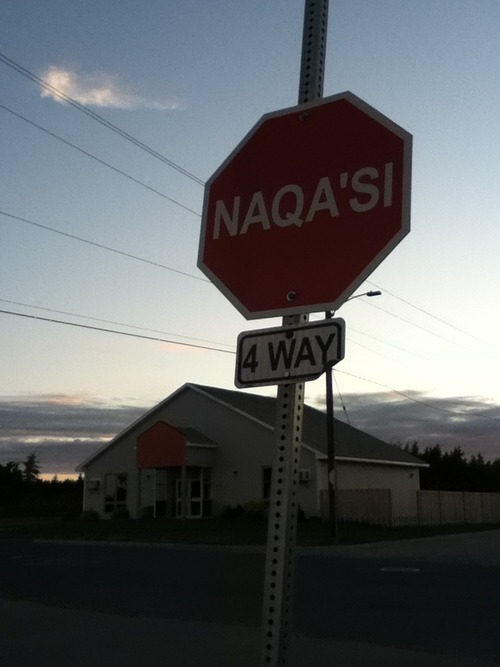
--- Stop signs in three languages: this and this one are endangered, this one isn't. Signage is about the easiest way to give an endangered language exposure where it otherwise would only be spoken at home, if that.

--- De Waarheid over Esperanto en Ido on Project Gutenberg, in Dutch with French translation below. Apparently it's by a member of the committee from way back when Ido was first proposed who preferred Esperanto. The Ido featured in the book is a bit archaic.

--- The first collection of data from Dawn has been made public, a total of 11,000 or so images from Approach, Survey, and High-Altitude Mapping Orbit.

--- The Pontifical Academy of Latinity has now been established. Some of the quotes from the article are pretty interesting, as the revival of Latin is seen by many in the church as being necessary to achieve a certain clarity of thought and to understand church doctrine. Along with that one also gets to read thousands upon thousands of ancient to medieval texts without needing a translation.

--- PressTV seems to like Esperanto.

Read more...

Link roundup for 10 November 2012

Sunday, November 11, 2012

First an interesting event from yesterday - at the local book store where a section is decked out in Hobbit-related literature and items for the upcoming movie, I found the following:


(Taken with a webcam as can't be bothered to find the real camera in the closet at the moment)

Hobbitus ille - The Hobbit in Latin. After buying it I've read a few reviews that say the translation is lacking in places. I'm not one to judge, though, and I have purchased it more to aid the revival of Latin than anything else, as I have no room to fit Latin into my schedule at the moment. I will skim through it while comparing it to the original English though just to get a feel for it. On that note we get to the next link:

--- Students learning introductory Latin at the University of Western Australia have increased by 150% this year. Want to know more? You can't without a digital pass, which I will not be getting.

--- Crecé interés por el mandarín - an article on the increasing interest in Mandarin in Paraguay. Slightly different from your average "the Confucius Institute is growing" article because this one is about Taiwan's role in teaching the language abroad.

--- Old Papiamentu text on a child's Dutch letter. Mi Alma dousje, Mi Courasson, Mi dousje, Mi bieda, Mi courasson.

--- An article on someone's experience using Memrise to learn about a thousand Lingala words to talk to pygmies in northern Republic of the Congo.

--- An article in French on how to save the Corsican language. Lots of discussion but no conclusion by the end on how to proceed.


And finally a link provided by a reader: a simple search displaying language programs for languages that are offered in North America. Entering Uzbek for example turns up 16 schools that offer it in the United States, Kalmyk is non-existent (no surprise), Kyrgyz gives five results, Cree gives 14 results all in Canada, Estonian gives 9 results.

Read more...

Billy the scarf, can't live without Brazil, Latin in Germany

Thursday, September 27, 2012

--- A good example of how good language learning materials have become lately, for the largest languages at least.

--- It's impossible to live without Brazil: an article in Portuguese on the role of Brazil in the Lusophone world, vis-à-vis China in particular.

--- I recently mentioned that Latin is undergoing a boom in Germany; now Deutsche Welle has written an English article on the subject.

Read more...

Latin up by 30% in Germany, is learned by one in ten students

Thursday, September 20, 2012

From here in German:

More than 7.5 million students learned English nationwide in 2010/2011, placing it well ahead of the others. After English follows French with more than a million and a half students. But in third place is a surprise: the dead language Latin with 800,000 students, far ahead of Spanish with 360,000. This means that one in ten students in Germany learns Latin. How has this happened? Has Harry Potter given Latinum a miraculous recovery? Whether this was the reason or not, the fact is that the number of Latin students since the beginning of the millenium has increased by 30 percent...Other languages follow: 104,000 students learn Russian in school, 58,000 Italian, 11,600 Turkish. Chinese is also undergoing a small boom: in 2010/2011 there were 232 schools in Germany that offer it, making up at least 5800 students.

Read more...

Latin Google Translate has improved somewhat

Friday, September 14, 2012

Google Translate added Latin in October 2010, and that day I tried translating a few example sentences. Ever since then I've tried out the same ones every few months to see if there has been any change, and nothing so far until I tried again yesterday, meaning that the improvements happened within the past two or three months. The original sentences and their results compared to the results now are:

I have two cats in my house.

  • October 2010: Habeo duas felis in domo Dei.
  • September 2012: Apud me habeo duas felis.


Extrasolar planets became an object of scientific investigation in the nineteenth century. Many astronomers supposed that they existed, but there was no way of knowing how common they were or how similar they might be to the planets of our solar system.

  • October 2010: Planetarum extrasolaris obiectum fuit investigatio scientifica saeculi XIX. Multi existimabant astronomis fuit, non fuit sciens viam communem aut quomodo sunt similes essent duodecim signis nostri Solaris systematis.
  • September 2012: Extrasolar planetarum factus obiectum perscrutatio scientialis in saeculi XIX. Existimabant plerique astronomi fuerit, sed modo scientia non sunt communes nobis et duodecim signis similia solari possent.


I live in Korea.

  • October 2010: Habito in Korea.
  • September 2012: Vivo ego in Korea.


Romans go home.

  • October 2010: Romans relinquatis.
  • September 2012: Romani ite domum.


Followed by the Latin to English samples. First from Sir Isaac Newton:

Aer duplo densior in duplo spatio quadruplus est. Idem intellige de Nive et Pulveribus per compressionem vel liquefactionem condensatis. Et par est ratio corporum omnium, quæ per causas quascunque diversimode condensantur. Medii interea, si quod fuerit, interstitia partium libere pervadentis, hic nullam rationem habeo. Hanc autem quantitatem sub nomine corporis vel Massæ in sequentibus passim intelligo. Innotescit ea per corporis cujusque pondus. Nam ponderi proportionalem esse reperi per experimenta pendulorum accuratissime instituta, uti posthac docebitur.

  • October 2010: The air is twice as twice as were thicker than the four times the space is. I understand about the same thing with snow, and dust through the compression or the melting power condensed. And the reasoning is of all bodies, which are of the causes of any are collected in different ways. Of the medium the mean time, if there was any, of free pervadentis interstices of the parts, here I have a no. But that this is under the name of the quantity or mass of the body in all directions in the following I understand. Is known to them through the body of each, the weight of the. For I have found the weight is proportional to the drawing on his experience of pendulums perfectly accurately for this purpose, is taught to use the hereafter.
  • September 2012: Twice the space is four times denser than the air twice. Understand it from the melting snow and dust by compression or condensate. And a pair of bodies is the reason for all things, which are collected in different ways by the causes whatsover. Of the medium in the mean time, if it is to be freely pervadentis interstices of the parties, in this case I have no reason. But that this is under the name of the body or of the quantity of the masses throughout in what follows I understand. It will be known by the body weight of each. It is proportional to the weight, I have found through experiments with pendulums, most accurate, as it will be later.


Finally, Julius Caesar:

Gallia est omnis divisa in partes tres, quarum unam incolunt Belgae, aliam Aquitani, tertiam qui ipsorum lingua Celtae, nostra Galli appellantur. Hi omnes lingua, institutis, legibus inter se differunt. Gallos ab Aquitanis Garumna flumen, a Belgis Matrona et Sequana dividit. Horum omnium fortissimi sunt Belgae, propterea quod a cultu atque humanitate provinciae longissime absunt, minimeque ad eos mercatores saepe commeant atque ea quae ad effeminandos animos pertinent important, proximique sunt Germanis, qui trans Rhenum incolunt, quibuscum continenter bellum gerunt. Qua de causa Helvetii quoque reliquos Gallos virtute praecedunt, quod fere cotidianis proeliis cum Germanis contendunt, cum aut suis finibus eos prohibent aut ipsi in eorum finibus bellum gerunt. Eorum una pars, quam Gallos obtinere dictum est, initium capit a flumine Rhodano, continetur Garumna flumine, Oceano, finibus Belgarum, attingit etiam ab Sequanis et Helvetiis flumen Rhenum, vergit ad septentriones. Belgae ab extremis Galliae finibus oriuntur, pertinent ad inferiorem partem fluminis Rheni, spectant in septentrionem et orientem solem. Aquitania a Garumna flumine ad Pyrenaeos montes et eam partem Oceani quae est ad Hispaniam pertinet; spectat inter occasum solis et septentriones.

  • October 2010: All Gaul is divided into three parts, one of which the Belgae inhabit, the Aquitani another, a third of those who in their language are called Celts, in our Gauls, the third. All these in language, customs, and laws differ from each other. Garonne separates the Gauls from the Aquitani the river, from the Belgae to the Marne and the Seine separate them. Of all these, Belgians are the bravest, because, as from the culture and civilization of the province they are absent, them the least often visited by merchants, and those things which tend to effeminate the minds of import, they are the nearest to the Germans, who dwell beyond the Rhine, with whom they are continually waging war;. For this reason, the Helvetii also precede the rest of the Gauls in valor, in almost daily battles with the Germans, when they either repel them from their own territories, or the men themselves in their territories, warring with them. One part of these occupied by the Gauls has been said, takes its beginning from the river Rhone, is included in the river Garonne separates the Gauls, the Ocean, and the territory of the Belgians, also attains of the Sequani and the Helvetii, the river Rhine, lies to the north. The Belgae rises from the ends of the frontier of Gaul, extend to the lower part of the river Rhine; and look toward the north and the rising sun. The river Garonne separates the Gauls from the Aquitaine to the Pyrenees mountains and to that part of the ocean which is near Spain: it looks between the setting of the sun and the north star.
  • September 2012: All Gaul is divided into three parts, one of which the Belgae inhabit, the Aquitani another, and a third who in their own language are called Celts, in ours Gauls. These all in language, customs and laws differ from each other. Aquitani and the river Garonne from the Gauls, Belgae from the Marne and the Seine divides. Of all these, the Belgae are the bravest, because the farthest removed from the culture and civilization of the Province, and merchants least frequently resort to them, and import those things which tend to effeminate the mind, they are the nearest to the Germans, who dwell beyond the Rhine, with whom they are continually waging war. For which reason the Helvetii also surpass the rest of the Gauls in valor, as they contend with the Germans in almost daily battles, when they either repel them from their own territories, or themselves wage war on their frontiers. One division of them than it has been said that the Gauls occupy, takes its beginning from the river Rhone, the river, the Atlantic, the Ocean, and the territory of the Belgae, it even reaches the Sequani and the Helvetii, upon the river Rhine, and stretches toward the north. The Belgae rises from the extreme frontier of Gaul, extend to the lower part of the river Rhine, look toward the north and to the east the sun. From the river Garonne Aquitaine to the Pyrenees mountains and to that part of the ocean which is near Spain: it looks between the setting of the sun, and the north star.


Read more...

  © Blogger templates Newspaper by Ourblogtemplates.com 2008

Back to TOP