Þ-Þ-Þák!
Sunday, June 21, 2015
How to chide your son in 15th century Norway for not speaking properly:


Interlinear books are bilingual translations where the original has a translation right below each word or expression. Try them out on Interlinear Books.
For multilingual verb conjugation, try CoolJugator - a tool that can currently conjugate in dozens of different languages. It also recognizes forms and provides examples for each verb.


How to chide your son in 15th century Norway for not speaking properly:
I found out today about a magazine by the name of Simplicissimus, which, despite its name, is devoted to Germanic-language articles. That is, articles in the magazine are either in English or in another Germanic language with English to the right. There is a lot of Dutch, a good amount of Afrikaans and Norwegian, and Scandinavian languages as well.
Now just to save any readers the time, they only accept submissions from Harvard undergraduate students, being a magazine affiliated with the school.
1. Submissions may be written in any Germanic language (including English), but must be about a Germanic topic.Read more...
2. Submissions must have been written at Harvard College or a Harvard-affiliated program by an undergraduate.
3. Submissions done as an undergraduate may be submitted by graduates if the submission is not older than two years.
4. Submissions will be chosen to be included in the journal by a majority vote of the present editorial board.
I noticed a bit of traffic coming from here last week, a discussion in Chinese of all languages about Anglish, including my proposal that textbooks for Germanic languages be written in Anglish, not English. The suggestion is a bit unrealistic, but to attempt to keep as many Germanic cognates as possible, and even using a few archaic terms, is not. When I did a translation of Aus Martins Tagebuch a month or so ago, for example, the word ereyesterday not only fit vorgestern much better than the day before yesterday, it also fit very nicely underneath.
Though the post is from five years ago I remember the reasons for writing it very cleary: seeing one too many times a textbook for German or Norwegian or something using Romance-derived terminology to explain a word when a Germanic one would have explained it better, and made it easier to remember. For snikskytter in Norwegian for example it's fine to show that the English equivalent is sniper, but if it doesn't mention that it's literally a sneakshooter, it is doing the student a disservice.
I get asked this question a lot, and it's nice to finally have the answer: it's Sigurdr, Jón and Olafr for boys, and Sigríðr, Gudrun and Ingibjǫrg for girls.
This article in Norwegian states that language preferences (besides English of course) among 8th graders in Norway have largely settled since about a decade ago, with the following numbers:
34.9% learn Spanish,
26.4% learn German,
14.7% learn French.
Apparently there are very few schools out there that offer anything but these three though, and other languages make up just 0.4% (234 students).
It then states that the private sector is concerned that there are not enough students learning German as it is the largest trading partner, in spite of the fact that it may not sound as sexy to students as French and Spanish: "Mange velger bort det fordi det kanskje ikke høres så sexy ut som fransk og spansk. Men vi handler mest med Tyskland, og det er stort behov for fagpersoner som kan tysk".
According to this link provided in a comment by a poster today which has made it very easy to write today's post. It reminds me a bit of a book I mentioned three years ago called Le français ne vient pas du latin which also makes a somewhat unorthodox yet interesting claim.
Back to the link: the claim is that Old English did exist as we know it, but then later died out and the language that took its place was Northern Germanic, naturally with a very heavy Old English influence. There was a lot of bitter confrontation for a while and by the time the Normans invaded England the two had more or less merged. One more reason: many of the words said to be adopted from Norse were very basic words like big and egg and skin, and to have adopted so many basic words when Old English already had its own words for them is difficult to believe. The final claim is word order, with some examples in the article as well as an article I wrote a few years back on why Norwegian is the easiest language for English speakers to learn.
I think I'll submit that link to /r/linguistics as well...wait, somebody already did today.
An article here in Spanish on how Spain has marginally better English proficiency than France and Italy shows a link to the source behind the map it presents - a site called the English Proficiency Index (pdf link there) that shows the proficiency of a few dozen countries in relation to each other. Unfortunately it is not comprehensive and does not include countries like Hungary, Estonia, Mongolia, etc. But for the countries it does feature it is worth taking a look at.
The index is also useful in planning one's study abroad to learn a language. You can see for example that one is much more likely to run into a fluent English speaker in Malaysia than Indonesia, and for Germanic fans it's worth noting that though Dutch may be closer to English and easier to learn than German, in Germany it's somewhat easier to find people that either are not too proficient in English or prefer not to use it.
A high English proficiency in a country does not mean that it is not worth going to, but you will have to change your strategy. Trying to use Norwegian just in the shops and restaurants will not be so easy, but if you arrange things ahead of time you can make it work. In countries like this it is best to hang out with about three people, because one or two makes it more likely that English is the common language between everyone, four and five and above makes it likely the group of friends will get carried off in their own subjects and inside jokes and leave you in the dust. In countries like this it is also good to become informed about local issues and politics. There is always a lot of specialized vocabulary in any country that is not often translated into other languages and/or without a direct translation into English of the original name, such as Kristelig Folkeparti (actually the Christian Democratic Party, not a literal translation). Celebrity nicknames, scandals, jokes that only work in one language, whatever you can find that both interests you and is much easier to discuss in that language compared to English will serve well.
Of course, the easiest technique is simply this: once in a country, only use the language spoken there even if it's awkward at first. Unless the information you need to get is absolutely crucial, a good rule of thumb is that the person you're talking to most likely is not going to ever see you again, and if he does not approve of your not using English with him and can't handle a less-than-fluent conversation in his own language then you don't need to talk with him anyway. In the end you're doing him a favour: you are probably spending money you earned in your country in his, and strengthening his language at the same time by refusing to use anything besides it. Just make sure you have at least some skill in the language before you leave or the only conversations you will be capable of having will be little different than the first few chapters in a language textbook, and the likelihood of finding someone willing to participate in one will be very small indeed.
Norwegian video with English subtitles:
Lots of discussion on this in Norwegian. Here are a few places:
-- In Norwegian, automatically translated. Subject: Learn German, Spanish or French?
-- In Norwegian, automatically translated Subject: German, Spanish or French?
-- In Norwegian, automatically translated Subject: Which language should I choose? Which is easiest?
-- In Norwegian, automatically translated Subject: Which language is easiest of Spanish and German?
-- In Norwegian, automatically translated Subject: German vs. French
-- In Norwegian, automatically translated Subject: Which language is most used, German or French?
-- In Norwegian, automatically translated Subject: French, German or Spanish?
The general consensus seems to be: German is the easiest to learn...then lots of debate over whether German, French or Spanish is best for a Norwegian to learn for practical purposes.
Two stories to share today:
Mentioned before here, Hispan TV is set to launch on Wednesday. This is I believe the Spanish equivalent of Press TV, a channel where one can get one's fill of pro-Iranian government stories. You can see the site here.
The other one worth mentioning is an image here from a Norwegian article here, showing the results of another study on the top languages used on Twitter. The results of this study were: 39% English, 14% Japanese, 12% Portuguese, 8% Spanish, 6% Malay, 3% Dutch, 2% Korean, 1% Arabic, 1% Thai, and 14% all others. As for why Chinese is not there: Twitter is blocked in China.
From here in Norwegian:
Norwegian student council wants to give degrees for free if they are done in emerging countries, but faces opposition from the Ministry of Education, NSO, and NTNU. The proposal was adopted by the Student Council in a discussion meeting on 6 October. "By growing economies we mean all economies that are experiencing great growth. At the present time we are talking about BRIC countries (Brazil, Russia, India, China) but in the long term it can include other countries with high growth", said director Per Martin Sandtrøen. According to ANSA (Association of Norwegian Students Abroad) there are 300 Norwegian students studying in China. Of these only 25 are getting an entire bachelor or master's degree, a number that Sandtrøen believes to be too low. "All the risk is on the students the way things work now. Taking an entire degree in these countries means that a person must support oneself for the entire first year, without any financial support...To work in the future in Norway we must educate students that know the language and conditions in these countries. The economic benefits would be far greater than what it would cost to educate them." he said.
From here in Norwegian:
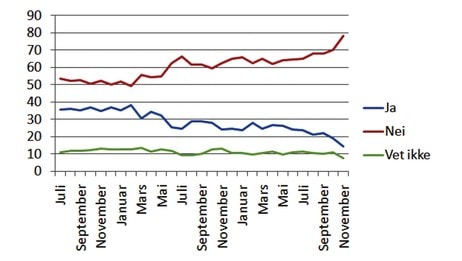
In a new poll carried out by Norstat for NRK, 78.3% of Norwegians say no to joining the EU. 7.5 of those asked say they haven't taken a position on EU membership, while just 14.3% say yes.
Norway, of course, remains strongly tied to the EU: 80% of its exports go to EU countries.
Also:
In a survey Sentio has done for Nei til EU (no to the EU), published today, only 44% of those asked said that they wanted to keep the current EEA (European Economic Area) agreement, while 38% say that they would vote no to if a referendum were to be held today.
From here today in Norwegian:
The government proposes to allocate a total of 843 million kroner ($152 million) for Sami language purposes in 2012, an increase of around 17 million kroner ($3 million).Read more...
Over the past three years the government has provided an increase of 23 million kroner ($4 million) for the Sami language in the government administration and church affairs budget.
Of the budget, 5.246 million kroner ($950,000) has been allocated to the Divvun project, which has developed spell checking and correction programs for North, Lule and south Sami. 2012 is the first year of full operation of Divvun at the University of Tromsø.
 |
| I think this is the school... |
Sharing links, closing open tabs, etc. as is often the case.
-----
The first article is this one on titanium deposits on the moon. We've known about titanium on the moon for a long time but apparently the fact that some parts are composed of 10% titanium is new. Titanium is common on Earth and so mining it to bring it back here would never happen, but as it is an extremely useful metal it's good to know for future colonization that there is so much there. In comparison, titanium on Earth only reaches up to about 1% abundance.
Google Alerts sent this link my way today, a guest article by the creator of a site called visual latin. The teacher seems to speak Latin with a pronunciation between reconstructed Roman and Ecclesiastic (plus an English accent). I prefer the videos found here, but a popular language should have all types of teachers promoting it and so the more the better.
Visual Latin | Sentences from Compass Cinema on Vimeo.
Today I had another go at the kind of simple "phrase book" one can make by using TED.com translations, this time with Norwegian and Icelandic. Hardly any talks there have been translated into Icelandic, and when picking a few languages to compare one must start with the least translated language first. This video has been translated into both Icelandic and Norwegian, and so allows us to make a rough comparison of the two languages. You'll notice that this method works best with languages that have a similar word order as it lets you divide up sentences into quite small parts, making it easier to look from one to the other.
Had today not been a workday I would have added a few others as well: Danish, Swedish, etc. This talk has been translated into quite a few given its popularity and short length.
As a boy, I loved cars.hversu heimskulegt það hafi verið að menn keyrðu bíla. Read more...
Som en liten gutt elsket jeg biler.
Þegar ég var yngri elskaði ég bíla.
When I turned 18, I lost my best friend to a car accident.
Da jeg ble 18, mistet jeg min beste venn i en bilulykke.
Þegar ég varð 18, missti ég besta vin minn í bílslysi.
Like this.
Som dette.
Bara sí svona.
And then I decided I'd dedicate my life to saving one million people every year.
Det var da jeg bestemte meg for å vie mitt liv til å redde en million mennesker hvert år.
Það var þá sem ég ákvað að helga líf mitt því að bjarga milljón manns á hverju ári.
Now I haven't succeeded, so this is just a progress report,
Jeg har ikke lykkes ennå, dette er bare en statusrapport,
Mér hefur ekki ennþá tekist það, svo þetta er bara framvinduskýrsla,
but I'm here to tell you a little bit about self-driving cars.
men jeg er her for å fortelle dere litt om selvkjørende biler.
en ég er hér til að segja ykkur dálítið frá bílum sem keyra sig sjálfir.
I saw the concept first in the DARPA Grand Challenges
Jeg så konseptet først i "DARPA Grand Challenges"
Ég varð hugmyndarinnar fyrst var í DARPA keppnunum
where the U.S. government issued a prize
hvor de amerikanske myndighetene gir ut en pris
þar sem ríkisstjórn Bandaríkjanna bauð þeim verðlaun
to build a self-driving car that could navigate a desert.
til de som kan bygge en selvstyrt bil som kan navigere seg gjennom en ørken.
sem gæti búið til ökumannslausan bíl sem keyrt gæti í gegnum eyðimörk.
And even though a hundred teams were there, these cars went nowhere.
Og selv om hundre lag hadde møtt opp, gikk bilene i hytt og pine.
Og þrátt fyrir þau hundrað lið sem þar voru, komust bílarnir ekki neitt.
So we decide at Stanford to build a different self-driving car.
Så vi bestemte oss ved Stanford for å bygge en selvstyrt bil.
Svo við við Standford háskóla ákváðum að byggja öðruvísi sjálfkeyrandi bíl.
We built the hardware and the software.
Vi bygget maskinvaren og programvaren.
Við bjuggum til vélbúnaðinn og hugbúnaðinn.
We made it learn from us, and we set it free in the desert.
Vi fikk den til å lære av oss, og vi satte den fri i ørkenen.
Við létum hann læra af okkur, og við hleyptum honum í eyðimörkina.
And the unimaginable happened:
Og det utrolige skjedde:
Og það óhugsandi gerðist:
it became the first car to ever return from a DARPA Grand Challenge
den ble den førstebilen som noen gang kom tilbake fra et Dharpa Grand Challenge løp
hann varð fyrsti bíllinn til að snúa aftur úr DARPA keppninni
-- winning Stanford 2 million dollars.
-- og vant 2 millioner dollar til Stanford.
-- og varð Stanford háskóla út um 2 milljónir dollara. einasta lífi.
Yet I still hadn't saved a single life.
Men jeg hadde ikke reddet et eneste liv ennå.
En þrátt fyrir það hafði ég ekki bjargað einu
Since, our work has focused on building driving cars
Siden det, har arbeidet vårt fokusert på å lage selvstyrte biler
Eftir það hefur vinna okkar snúist um það að byggja bíla
that can drive anywhere by themselves
som kan kjøre hvor som helst på egen hånd
sem geta keyrt hvert sem er af sjálfsdáðum
-- any street in California. We've driven 140,000 miles.
-- en hvilket som helst gate i California. Vi har kjørt 225.000 kilometer.
-- hvaða götu sem er í Kaliforníu. Við höfum keyrt 225.000 kílómetra.
Our cars have sensors by which they magically can see everything around them
Våre biler har sensorer som tillater dem å se alt rundt dem
Bílar okkar hafa skynjara sem þeir nota til að sjá á undraverðan hátt allt sem í kringum þá er
and make decisions about every aspect of driving.
og ta beslutninger vedrørende alle aspekter rundt kjøring.
og taka ákvarðanir um allt tengt akstrinum.
It's the perfect driving mechanism.
Det er den perfekte kjøremekanismen.
Þetta er hin fullkomna ökutækni.
We've driven in cities, like in San Francisco here.
Vi har kjørt i byer, som i San Francisco her.
Við höfum keyrt í borgum eins og hér í San Francisco.
We've driven from San Francisco to Los Angeles on Highway 1.
Vi har kjørt fra San Francisco til Los Angeles på Highway 1.
Við höfum keyrt frá San Francisco til Los Angeles á Hraðbraut 1.
We've encountered joggers, busy highways, toll booths,
Vi har møtt joggere, travle motorveier, bomveier,
Við höfum glímt við skokkara, þunga umferð á hraðbrautum, tollbása,
and this is without a person in the loop;
og dette uten en person involvert,
og allt þetta án þess að blanda manni í ákvarðanatökuna;
the car just drives itself.
bilen kjører seg selv.
bíllinn keyrir sig bara sjálfur.
In fact, while we drove 140,000 miles, people didn't even notice.
Faktisk, mens vi kjørte de 225.000 kilometrene så merket ikke folk det engang.
Satt best að segja, þegar við keyrðum þessa 225.000 kílómetra, tók fólk ekki einu sinni eftir því.
Mountain roads, day and night,
Fjellveier, dag og natt,
Fjallvegir, dag og nótt,
and even crooked Lombard Street in San Francisco. (Laughter)
til og med svingete Lombard Street i San Francisco. (Latter)
og jafnvel hið hlykkjótta Lombard stræti í San Francisco. (Hlátur)
Sometimes our cars get so crazy, they even do little stunts.
Noen ganger blir bilene våre så gale, at de til og med gjør små stunts.
Stundum eru bílarnir okkar svo villtir, að þeir sýna smá áhættuatriði.
(Video) Man: Oh, my God. What? Second Man: It's driving itself.
(Video) Mann: Åh, herregud. Hva? 2.Mann: Den kjører av seg selv.
(Myndband) Maður: Guð minn góður. Hvað? Annar Maður: Hann keyrir sig sjálfur.
Sebastian Thrun: Now I can't get my friend Harold back to life,
Sebastian Thrun: Jeg kan ikke få tilbake min venn Harold,
Sebastian Thrun: Ég get ekki vakið vin minn Harold upp frá dauðum,
but I can do something for all the people who died.
men jeg kan gjøre noe for alle folkene som døde.
en ég get gert dálítið fyrir allt það fólk sem hefur dáið.
Do you know that driving accidents are the number one cause of death for young people?
Visste du at bilulykker er den største dødsårsaken for unge mennesker?
Vissuð þið að umferðarslys eru algengasta dánarorsök ungs fólks?
And do you realize that almost all of those are due to human error
Og visste du at nesten alle er på grunn av menneskelige feil
Og vissuð þið það að nánast öll þessi slys eru af völdum mannlegra mistaka
and not machine error, and can therefore be prevented by machines?
og ikke tekniske feil, og kan dermed bli forhindret av maskiner?
en ekki vélrænna mistaka, og eru þar af leiðandi fyrirbyggjanleg af vélum?
Do you realize that we could change the capacity of highways by a factor of two or three
Skjøner du at vi kan endre kapasiteten på motorveien med en faktor på to til tre
Áttið þið ykkur á því að við getum breytt flutningsgetu hraðbrauta tvö- eða þrefalt
if we didn't rely on human precision on staying in the lane --
om vi ikke trenger bry oss om menneskelig presisjon for å holde oss i rett fil --
ef við reiddum okkur ekki á mannlega nákvæmni þegar kemur að því að halda sig innan akreinar --
improve body position and therefore drive a little bit closer together
forbedret posisjon og kjør litt nærmere
bæta líkamsstöðu og þar af leiðandi keyrt nær hvert öðru
on a little bit narrower lanes, and do away with all traffic jams on highways?
på smalere filer, og vi er kvitt køer og kaos på motorveiene?
á örlítið mjórri akreinum, og komist hjá öllum umferðarteppum á hraðbrautum?
Do you realize that you spend an average of 52 minutes per day in traffic,
Visste du at du bruker gjennomsnittlig 52 minutter hver dag i kø,
Áttið þið ykkur á því að þið eyðið að meðaltali 52 mínútum á dag í umferðinni,
wasting your time on your daily commute?
kaster bort tid på din daglige tur til jobb?
að sóa tíma ykkar á ykkar daglega ferðalagi?
You could regain this time.
Du kan få tilbake denne tiden.
Þið gætuð endurheimt þennan tíma.
This is four billion hours wasted in this country alone.
Det er fire billioner timer som blir kastet bort i dette landet alene.
Þetta eru fjórir milljarðar klukkutíma sem er sóað í einungis þessu landi.
And it's 2.4 billion gallons of gasoline wasted.
Og det er 9 billioner liter med drivstoff som kastes bort.
Og að það eru 9 milljarðar lítra af bensíni sem er sóað.
Now I think there's a vision here, a new technology,
Jeg tror det er en ny visjon her, en ny teknologi,
Ég tel að hér sé á ferðinni ný framtíðarsýn, ný tækni,
and I'm really looking forward to a time
og jeg ser virkelig fram til en tid
og ég hlakka verulega til þess tíma
when generations after us look back at us and say
hvor generasjoner etter oss ser tilbake på oss og sier
þegar komandi kynslóðir líta til baka á okkur og segja
how ridiculous it was that humans were driving cars.
hvor tullete var det ikke at mennesker kjørte biler.
This article in Norwegian from Voice of Russia says that the Olympic stamps for the Winter Olympics in Sochi will be in six languages: Russian, English, French, German, Spanish, and Chinese, and one stamp costs 15-30 rubles or 0.5 - 1 dollars. Apparently this is the largest number of languages to be included on Olympic stamps.
One other note about the site itself: in some of its many languages you can find audio articles with matching text, which is good for relatively uncommon languages like Czech. See this article for example.
Time to get rid of a few tabs I've had up for a week or so that I haven't found the desire to write a full post about. The first one is:
this article in Norwegian from today on high-speed rail linking Norway, Sweden and Denmark. It seems Norway wants to see a train that goes at 330 kph, but Sweden is not interested in one over 250. The argument behind the faster train is that it would not be possible to get to Copenhagen within 3 hours, and 3 hours is thought to be a magic number - under 3 hours and people will prefer to use the train, over 3 hours and they tend to remain in favour of flying. The train between Oslo and Stockholm might end up going 330 kph within Norway, then slowing down to 250 kph after entering Sweden since the tracks will be incapable of maintaining the higher speed. The Norwegian side seems to be surprised that Sweden is not interested in anything over 250 kph, and maybe a more informed reader can tell us why this is.
Another film has been translated into Sambahsa. It's called Kaydara and is about an hour long, seems to be heavily based on The Matrix, and to see the subtitles in Sambahsa you have to choose Serbian since only previously approved languages can be selected. The movie already has subtitles in Croatian so the Sambahsa subtitles won't keep any Serbs from watching and enjoying the movie. I was supposed to watch it by now but it's longer than I thought (I guessed about 25 minutes) and now my time is limited due to working full time.
Your commute is killing you - an article on the link between long commutes and depression, obesity, etc.
Die Burger - an article on the Afrikaans newspaper and how its success. Its motto is Lees die Burger en praat saam.
A statement by Frank L. Culbertson (commander of the International Space Station for a time) to a Congress subcommittee where he defends the role of the ISS and the research done there.

The battle for engineers is fierce, and many of the largest engineering companies in Norway are showing a need for more of them. Norway needs thousands of engineers, as at the moment only about half of the engineers it needs are being trained in the country. Around 3000 engineers are trained in Norway every year, but according to a survey conducted by Nav (Norwegian Labour and Welfare Organization, or Arbeids- og velferdsforvaltningen) there were 6310 engineers needed in Norway in 2010.Numbers from another survey:
AF Gruppen alone would like to hire about 600 engineers, preferably experienced, but they may not have a choice in the matter.
6 out of 10 employers in the private and public sector that recruit engineers say that they will need more engineers in the next three years, and 6 of 10 think that it will be difficult for them to find qualified engineers.And finally the bit on Mars. You can see their website here (all in Norwegian) on the project.
The campaign "Bli med og bygge på Mars" (Join (us) and build on Mars) challenges participants to come up with concrete solutions in construction, infrastructure, transport, building, property, environment and energy for Mars..."In order for humans to be able to live and reside on Mars, we will first have to build protective capsules, after which you will be able to live in an artificial atmosphere. This is called terraforming, whereby one makes Mars into an inhabitable environment like Earth", said astrophysicist Knut Jørgen Røed Ødegaard in a comment on the subject.
Through the contest "Bli med og bygge på Mars" AF Gruppen invites creative engineers, students and others to participate in the development of an environmentally friendly and futuristic plans and technological solutions for the planet Mars. The prize is a trip to space.Read more...
© Blogger templates Newspaper by Ourblogtemplates.com 2008
Back to TOP