Showing posts with label norway. Show all posts

Norwegian 8th graders like Spanish, German, and French

Sunday, December 23, 2012

This article in Norwegian states that language preferences (besides English of course) among 8th graders in Norway have largely settled since about a decade ago, with the following numbers:

34.9% learn Spanish,
26.4% learn German,
14.7% learn French.

Apparently there are very few schools out there that offer anything but these three though, and other languages make up just 0.4% (234 students).

It then states that the private sector is concerned that there are not enough students learning German as it is the largest trading partner, in spite of the fact that it may not sound as sexy to students as French and Spanish: "Mange velger bort det fordi det kanskje ikke høres så sexy ut som fransk og spansk. Men vi handler mest med Tyskland, og det er stort behov for fagpersoner som kan tysk".

Read more...

Norway looking for 5000 Portuguese engineers

Friday, October 05, 2012

An article here in Portuguese today on two themes sometimes followed here - the need for engineers in countries like Norway and Germany, and the exodus of talent from Portugal. In spite of a different language, going to Norway to work probably feels like less of a true exodus than somewhere like Brazil or Angola - a flight from Lisbon to Oslo is just three and a half hours. In contrast, Brazil is about ten hours away and Angola about eight hours. Then there are also the various supranational bodies in and around the EU such as the Schengen Treaty that both Norway and Portugal are members of:


So, to the article:

Numerous job offers from abroad are arriving at the Order of Engineers. International companies are seeking professionals from all sectors of engineering, and are even asking the Order to make the selection for them. The last major bid that arrived at the Order was from Norway, seeking 5000 engineers.

The Order does not make selections, but divulges the offers that arrive. Norway is one of the countries where professionals in the area are most lacking, similar to Germany, Mozambique and Angola (Luanda).

The article then provides a helpful link for those that are interested in applying for a position as an engineer there.

So which languages gain in a situation like this? 1) English (will certainly serve as the common language between a Norwegian employer and Portuguese engineer), 2) Norwegian (many engineers may opt to learn the language due to encountering it outside of the office all the time).

Read more...

Norwegian mysterious package with unknown content to open today

Friday, August 24, 2012

Norwegian video with English subtitles:

Read more...

Norwegians debating the importance and ease of German, French, and Spanish

Friday, May 25, 2012

Lots of discussion on this in Norwegian. Here are a few places:

-- In Norwegian, automatically translated. Subject: Learn German, Spanish or French?
-- In Norwegian, automatically translated  Subject: German, Spanish or French?
-- In Norwegian, automatically translated  Subject: Which language should I choose? Which is easiest?
-- In Norwegian, automatically translated  Subject: Which language is easiest of Spanish and German?
-- In Norwegian, automatically translated  Subject: German vs. French
-- In Norwegian, automatically translated  Subject: Which language is most used, German or French?
-- In Norwegian, automatically translated  Subject: French, German or Spanish?

The general consensus seems to be: German is the easiest to learn...then lots of debate over whether German, French or Spanish is best for a Norwegian to learn for practical purposes.

Read more...

Ålesund in amazing detail

Saturday, December 17, 2011

Ålesund, Norway, is one of the prettiest cities in Europe and is apparently also fairly inexpensive compared to other parts of the country. But what's the best way to really take a look at the city?

The answer to that is obviously Google Street View, as Ålesund has been available for perhaps a year now. But one other fun way is this image, taken from the top of the mountain that everybody goes up to look at the city from above. This image is zoomable and goes into some pretty good detail at maximum magnification, showing people walking, individual roof tiles, cars, satellite dishes, the backs of buildings bordering on the ocean, all the areas that Google Street View was never able to image. Zooming in and looking around is very addictive.

Read more...

Norwegian student council wants students to get degrees in BRIC countries for free

Monday, November 14, 2011

From here in Norwegian:

Norwegian student council wants to give degrees for free if they are done in emerging countries, but faces opposition from the Ministry of Education, NSO, and NTNU. The proposal was adopted by the Student Council in a discussion meeting on 6 October. "By growing economies we mean all economies that are experiencing great growth. At the present time we are talking about BRIC countries (Brazil, Russia, India, China) but in the long term it can include other countries with high growth", said director Per Martin Sandtrøen. According to ANSA (Association of Norwegian Students Abroad) there are 300 Norwegian students studying in China. Of these only 25 are getting an entire bachelor or master's degree, a number that Sandtrøen believes to be too low. "All the risk is on the students the way things work now. Taking an entire degree in these countries means that a person must support oneself for the entire first year, without any financial support...To work in the future in Norway we must educate students that know the language and conditions in these countries. The economic benefits would be far greater than what it would cost to educate them." he said.

Opposition to the idea seems to have more to do with implementation than anything else: the Ministry of Education and others don't believe it's an easy task to educate Norwegian students in countries that don't offer much education in English and don't think students would be prepared to learn in other languages by the time they get there either, and there is also difficulty in finding places that meet Norwegian education requirements.

Read more...

Record high 78.3% of Norwegians say no to EU membership

Friday, November 11, 2011

From here in Norwegian:

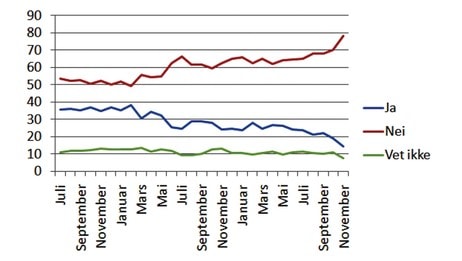
In a new poll carried out by Norstat for NRK, 78.3% of Norwegians say no to joining the EU. 7.5 of those asked say they haven't taken a position on EU membership, while just 14.3% say yes.

Norway, of course, remains strongly tied to the EU: 80% of its exports go to EU countries.

Also:

In a survey Sentio has done for Nei til EU (no to the EU), published today, only 44% of those asked said that they wanted to keep the current EEA (European Economic Area) agreement, while 38% say that they would vote no to if a referendum were to be held today.

See here for a chart showing yes/no/undecided opinion since July 2009. During that time the highest positive response for EU membership was about 49% no, 39% yes, 12% undecided in February 2010.

Read more...

Norway increases funding for Sami by $3 million

Tuesday, November 01, 2011

From here today in Norwegian:

The government proposes to allocate a total of 843 million kroner ($152 million) for Sami language purposes in 2012, an increase of around 17 million kroner ($3 million).

Over the past three years the government has provided an increase of 23 million kroner ($4 million) for the Sami language in the government administration and church affairs budget.

Of the budget, 5.246 million kroner ($950,000) has been allocated to the Divvun project, which has developed spell checking and correction programs for North, Lule and south Sami. 2012 is the first year of full operation of Divvun at the University of Tromsø.

Read more...

Chinese language more and more popular in Norway

Saturday, October 22, 2011

I think this is the school...
This article from regional NRK news is shy on numbers but references a general trend towards choosing Chinese as a second foreign language after English. It's based in Trondheim and features Sverresborg Secondary School students. In that school this is the third year that Chinese has been an option, and students have to choose a second language after English, usually French, German, Spanish, and also Chinese. The article is kind of random and not exactly the kind of style I enjoy reading through and writing about, but it's a fairly interesting snapshot of increased Chinese interest in a local area in a country quite far from China.

Some interviews with the students, skipping that...right after an interview with one we have "he is one of about 200 Norwegian secondary that have chosen Chinese as their second foreign language, and there are more and more according to the foreign language centre in Halden. Students from every city have in three years taken the bus to Sverresborg Secondary School to learn Chinese, but now the school is able to fill classes with its own students. This is why there are only 10th graders from other schools that travel to Sverresborg to learn the language this year. "We are very pleasantly surprised that so many are interested in learning Chinese. We see an increase from year to year", says Rector Bernt Aune."

After that unsatisfying article I think I'll try to find some clear nationwide information to show exactly how much interest there is in Chinese there compared to X number of years ago.

Read more...

Norwegian PM's response to attacks and shootings in Norway yesterday

Sunday, July 24, 2011

Here is the video with English subtitles, and the original Norwegian below from here.


Read more...

Link roundup for 29 May 2011 - high speed trains in Norway, the morning commute and depression, another movie translated into Sambahsa...

Monday, May 30, 2011

Time to get rid of a few tabs I've had up for a week or so that I haven't found the desire to write a full post about. The first one is:

this article in Norwegian from today on high-speed rail linking Norway, Sweden and Denmark. It seems Norway wants to see a train that goes at 330 kph, but Sweden is not interested in one over 250. The argument behind the faster train is that it would not be possible to get to Copenhagen within 3 hours, and 3 hours is thought to be a magic number - under 3 hours and people will prefer to use the train, over 3 hours and they tend to remain in favour of flying. The train between Oslo and Stockholm might end up going 330 kph within Norway, then slowing down to 250 kph after entering Sweden since the tracks will be incapable of maintaining the higher speed. The Norwegian side seems to be surprised that Sweden is not interested in anything over 250 kph, and maybe a more informed reader can tell us why this is.

Another film has been translated into Sambahsa. It's called Kaydara and is about an hour long, seems to be heavily based on The Matrix, and to see the subtitles in Sambahsa you have to choose Serbian since only previously approved languages can be selected. The movie already has subtitles in Croatian so the Sambahsa subtitles won't keep any Serbs from watching and enjoying the movie. I was supposed to watch it by now but it's longer than I thought (I guessed about 25 minutes) and now my time is limited due to working full time.

Your commute is killing you - an article on the link between long commutes and depression, obesity, etc.

Die Burger - an article on the Afrikaans newspaper and how its success. Its motto is Lees die Burger en praat saam.

A statement by Frank L. Culbertson (commander of the International Space Station for a time) to a Congress subcommittee where he defends the role of the ISS and the research done there.

Read more...

More oil for Norway (Italy benefits a bit too)

Saturday, April 02, 2011

Here's an article from Welt today that is certainly already available in other languages, but we'll condense the information from this one:

It's the most important oil find in Norway for ten years. The Norwegian energy company Statoil has made a "remarkable" oil discovery in the northern Barents Sea, 200 km north of the coast. The overall potential of the so-called "Skrugard Prospect" is 500 million barrels, and they want to start work on the field "as soon as possible".

Statoil has 50% of the field, the Italian energy company Eni has 30%, and the remaining 20% is owned by the Norwegian state company Petoro. Statoil is confident that they will be able to find reserves similar to this in the future as well.

It seems to be located somewhere around here.


View Larger Map

Read more...

Ny i Norge is offered in five languages (including Norwegian) - any guesses?

Ny i Norge (new in Norway) is offered in five languages, and the inclusion of one is particularly interesting. The five languages are:


Norwegian (of course)


English (no surprise here)


Polish


German


and....


Lithuanian.

It's not very often that a Lithuanian is able to get information in his/her own language from another country.

Read more...

Norway needs thousands of engineers

Wednesday, March 30, 2011

Here is an interesting article from DN.no in Norwegian yesterday. The article is quite a bit longer than the parts I've translated with the most important numbers, and even goes into a search for engineers by AF Gruppen in a contest of theirs to design a settlement on Mars, with the winner getting a trip to space as the prize. With its high quality of living index, second highest GDP per capita in the world, (relatively) easy language to learn for English speakers and all the other things that make Norway great, engineers from other countries would be well advised to keep an eye out for the opportunity to move there if they feel the urge to move to and work in another country.
The battle for engineers is fierce, and many of the largest engineering companies in Norway are showing a need for more of them. Norway needs thousands of engineers, as at the moment only about half of the engineers it needs are being trained in the country. Around 3000 engineers are trained in Norway every year, but according to a survey conducted by Nav (Norwegian Labour and Welfare Organization, or Arbeids- og velferdsforvaltningen) there were 6310 engineers needed in Norway in 2010.

AF Gruppen alone would like to hire about 600 engineers, preferably experienced, but they may not have a choice in the matter.
Numbers from another survey:
6 out of 10 employers in the private and public sector that recruit engineers say that they will need more engineers in the next three years, and 6 of 10 think that it will be difficult for them to find qualified engineers.
And finally the bit on Mars. You can see their website here (all in Norwegian) on the project.
The campaign "Bli med og bygge på Mars" (Join (us) and build on Mars) challenges participants to come up with concrete solutions in construction, infrastructure, transport, building, property, environment and energy for Mars..."In order for humans to be able to live and reside on Mars, we will first have to build protective capsules, after which you will be able to live in an artificial atmosphere. This is called terraforming, whereby one makes Mars into an inhabitable environment like Earth", said astrophysicist Knut Jørgen Røed Ødegaard in a comment on the subject.

Here's a video from YouTube on the contest:


Through the contest "Bli med og bygge på Mars" AF Gruppen invites creative engineers, students and others to participate in the development of an environmentally friendly and futuristic plans and technological solutions for the planet Mars. The prize is a trip to space.

Read more...

Gunnar Wetterberg believes the Nordic countries should form a union by 2030

Friday, March 25, 2011

From an article here in Norwegian, that already has 433 replies in the comments section below. If the subject piques your interest but you don't know Norwegian then going through the comments section with Google Translate should be well worth your time.

We will be one of the strongest economies in the world, says the Swedish historian.

Today is Nordens Dag, which commemorates the basic agreement of cooperation between the Scandinavian countries that was signed in Helsinki in 1962.

All representatives from the Nordic countries were invited to Trondheim to mark the day. The Swedish historian Gunnar Wetterberg held a lecture today where he presented an exciting proposal: to merge the five Nordic countries into a single federal state. "When these countries are so near to each other in language and culture, it is no wonder that we were together not so long ago...We will have a very strong base for economic growth in the area, much stronger than we have when our countries are working separately."

There have been many Nordic unions over the centuries, but they have never quite worked. Wetterberg believes there are other causes behind that: "Perhaps there were others outside the region that didn't want it to go so well. For example the Dutch and English would not want both sides of Øresund (the strait between Denmark and Sweden) to belong to the same country...We also ended up in the middle of the USA and Soviet Union during the Cold War."

On the possibility of internal strife in such a union he says that "It has always been the case in Europe that one group fights with another. But now, after 600 years, the great powers are finally leaving us alone." On the possibility that Sweden would dominate such a union: "The Swedes are not so high on the pole any longer either, because you (Norwegians) are richer than us, Finns are better with technology, and the Danes did a better job getting through the financial crisis than we did. None of the lands would end up being Big Brother, and we will go together on equal terms."

Gunnar Wetterberg is optimistic about the timeframe, and believes it could be done around 2030. "The interesting thing is that the population has been in the forefront of this. 1 of 10 employees in Oslo are Swedish, and three percent of the population in Malmö (just across the bay from Denmark) commute across the bridge to Denmark to go to work. It's happening today, and now it is just up to politicians to put a frame on it."

Just to provide some economic background, the "core" Scandinavian countries of Sweden, Norway and Denmark together would have a GDP in between Australia and Mexico - right now the highest, Sweden, is 21th in terms of GDP but together they would be in 14th place. With Finland and Iceland added it would be around $1.4 trillion, in between Spain and India. Population of the core three together would be around 20 million, then add another 5 million to that with Finland and Iceland.

The inclusion of Finland would make such a union a political and not a linguistic one, since Finland only has Sweden as a nominal official language (with many Swedish speakers, but still a minority) while Finnish is from a completely different language family. Also, since Denmark is technically sovereign over the Faroese Islands (where the language is very similar to Icelandic) a union of even the first three countries would have a group of insular Scandinavian speakers anyway. And let's not forget Elfdalian (yes, that's a real language).

Read more...

Starbucks is finally coming to Norway - by 2014

Wednesday, February 02, 2011

Norway's NRK tells us in an article here today that Starbucks is finally planning to come to Norway. One would assume that a country like Norway would have already had a few locations, but looking at the map that's not the case:


Interestingly, no Starbucks in coffee-guzzling Finland either.

NRK's article is surprisingly negative on the idea. Here's the gist of it:

The US coffee chain Starbucks will start business in Norway by 2014. Starbucks will first establish itself at traffic junctions, but hopes to then open up mainstream coffee bars in Oslo.

Communications directer Carole Pucik to Dagens Næringsliv: "We know the Scandinavian market very well, and will definitely get into the Norwegian market. The possibility is very high that we will be there in three years."

On the other hand we have social scientist Erling Holm Dock, who is not so sure. "Starbucks will struggle if they want to get into the street level area in Olso, Bergen and Trondheim. The best locations are already taken, and Starbucks serves worse coffee than the leading Norwegian coffee bars such as Kaffebrenneriet and Stockfleths." He believes that the only place where Starbucks can be competitive are inside malls and airports. "They could compete well with cafés such as Upper Crush in Gardermoen (Oslo Airport) or hybrid kiosks like Deli de Luca at shopping centers, but they'll need to work hard to compete with the best Norwegian coffee bars."

Studies show that 75% of the Norwegian market knows the Starbucks name and logo, and Starbucks has 50,000 Norwegian fans on Facebook.

Dock Holm then said that one of the attractions to Starbucks is its exotic nature, and that being available on the streets in Norway would damage this image as a coffee shop from abroad.

The comments below the article are also divided - not so divided on Starbucks actually coming to Norway (a new coffee shop is always exciting) but whether they will succeed. Some think the Norwegian coffee shops are better, others think their service sucks and Starbucks will blow them out of the water, others think it doesn't matter since Starbucks is a brand and doesn't need to be better than the competition anyway to succeed.

Read more...

Norwegian app makes it possible to get organ donor card by cellphone

Tuesday, January 18, 2011

Some news in Norwegian from NRK here on organ donation that seems easily doable in other countries as well. There is actually nothing radically different about this donor card compared to one using paper except that it makes it easier to carry around and inform the next of kin. It looks like this:


Some info from the article:

-----

Would you want your organs to live on when you die?

Only 0.5% of all deaths are relevant to organ donation. And it is your own attitude that decides whether your organs are given away or not, whether through what you've said to your loved ones or through carrying a donor card on you.

Until now donor cards have been paper documents that you must carry with you. But Stiftelsen Organ Donation has launched a card as an iPhone and Android application.

"The card is easier to carry with you, but the most important thing is that it makes it easier to inform your loved ones", says information consultant Troels N. Mathisen.

The point of a donor card is to show that you have informed your relatives that you are okay with organ donation.

"It is the families that have to answer for the dead, but in practice it can be difficult to have that conversation", says Mathisen. "The mobile donor card is not activated until you have added two relatives from your telephone list. When you activate the card, they are sent an automatic SMS, which becomes the starting point for the conversation."

The SMS it sends out looks like this:

«Hei! Jeg har fått meg elektronisk donorkort og sier ja til organdonasjon. Du er oppført som pårørende. Les mer om donorkort her: http://www.donorkort.no»

= "Hey! I have gotten an electronic donor card and said yes to organ donation. You are listed as next of kin. Read more about donor cards here: http://www.donorkort.no"

The donor card can be made easily visible on the phone even if it is locked. But Mathisen notes that "from our experience we can say that the most important thing isn't carrying the card with you, it's that the next of kin know what you want. If you are the victim of an accident, the ambulane personnel aren't going to be spending time looking for a donor card, they'll be spending time trying to save your life. If the situation is such that organ donation is appropriate, then the next of kin get the question "what did this person think about organ donation?" It's good to have a clear answer on that."

Organ donation is only applicable with 0.4 to 0.5% of deaths. There are now not enough donors to help everyone on waiting lists. Every year 30 people die while waiting in line for new organs.


There is also an info chart on the right, with the following (among other points):

- Only people who die of head trauma can be donors.
- If your body is applicable to organ donation, your next of kin answer as to what you would want.
- You can choose whether you want to donate any applicable organs, or whether you only want to donate certain organs. But you can't choose who will get them.

Read more...

Foreign Minister Støre: Norway might be willing to recognize an independent Palestinian state in September 2011

Saturday, January 15, 2011

Some news from NRK yesterday, as the Norwegian Foreign Minister was just in the area and fielded some questions on whether Norway intends to recognize an independent Palestinian state in September or not. Norway's a particularly interesting case to watch considering that it is not a part of the EU, but nor does it have a strict policy of neutrality in international affairs.
Foreign Minister Jonas Gahr Støre said on Wednesday while in Ramallah in the West Bank that Norway could recognize a Palestinian state, saying that "We are working to develop the Palestinian economy so that they can achieve the goal of independence." Palestinians are seeking to proclaim an independent state in September, according to a two-year plan from Prime Minister Salam Fayyad. Støre said that Norway would support this work.

There are only eight months until the target, and Støre believes that time is running out. "If there is no progress on the political track by August or September, I think the climate will change." He also said that Norway would be one of the first countries in Europe to recognize a Palestinian state in the fall, if it is coordinated internationally.

Donors to the Palestinian territories will reassess the situation in September, says NRK's Middle East correspondent Sidsel Wold, noting that donor countries would reassess the situation in September: "Norway is leading the donor group for Palestine, which has been very important in the past half year because of the September 2011 deadline...if the peace process just gets stuck and nothing happens, you have to figure out whether to liquidate a postion of the financial support, or what to do."

Minister Støre says that the EU represents a large number of countries and that they are divided over the issue, while the US is somewhat less involved because of preparations for the next presidential election. This makes Norway a somewhat more important player, he said.

Another article featuring a the same quotes from Støre also has the following:

The time is not ripe for a Palestinian state, believes Israel's Foreign Minister Avigdor Lieberman, saying that the Palestinian government lacks legitimacy: "This is an administration that has delayed elections three times, that lost the last election, that is not holding elections and is not acting to hold them. There is no guarantee that Hamas would win the next time an election is held."

Hamas won the election in the Palestinian territories in 2006, but never took control over the Fatah-controlled security forces. That eventually led to an armed conflict in the Gaza Strip, and security forces were eventually expelled from it.
While we're on the subject, don't forget this post that compares the size of the Gaza Strip to other parts of the world. Two of the maps there comparing it to New York and Vancouver serve as good examples:


View Gaza Strip vs. US and other locations in a larger map


View Gaza Strip vs. US and other locations in a larger map

Read more...

Boat sinks in north Norway, dialect is heard

Saturday, December 04, 2010

Fire broke out in a boat today in north Norway and it sank, and when an NRK reporter that went out to interview one of the crew it turned out that his Norwegian was more or less impossible to understand for your average Norwegian from the south. You can hear him in the video here in the article.


They then joke about what he could be saying - was Obama behind the fire perhaps?

This has something to do with a pet peeve of mine, comments that claim that Norwegian or any other language is hard to learn because it has a lot of dialects. Well yes, if you're expected to learn each and every dialect. But if Norwegians themselves can't understand each and every one, then to claim that Norwegian is hard for a speaker of English or any other language to learn because of this is a silly claim to make. Either it is hard to learn because it has a ton of dialects (that every native speaker knows), or it has a ton of dialects but the average person doesn't know them all, and neither is a person studying Norwegian as a foreign language expected to know them all either.

One might as well say that in order to be a fluent English speaker you have to be able to understand 100% of what Boomhauer says. Have fun:

Read more...

Iranian ex-diplomat in Norway: alleged attack on Ahmadinejad was a PR stunt

Friday, August 06, 2010

Here's an article in Norway's NRK today quoting Mohammad Reza Heydari (محمد رضا حیدری), the former Iranian diplomat (most recently consul in the Iranian Embassy in Oslo) who believes that the news of attacks on Ahmadinejad two days ago were staged. This is on the front of NRK right now but is not in any other language, and Balatarin (Persian Reddit/Digg) doesn't even have it yet so Norwegian only for the moment. Some of the article:

Mohammad Reza Heydari worked as a diplomat for the Iranian regime for 20 years. He believes the attempted attack on Mahmoud Ahmadinejad was staged by the regime itself.

– Ahmadinejad wants to create publicity around himself, and yesterday he succeeded in doing just that, said the ex-diplomat Mohammad Reza Heydari to NRK.

Heydari worked as a diplomat for the Islamic Republic for 20 years, most recently as Consul at the Iranian Embassy in Oslo. Earlier in the year he resigned in protest against the clerical regime's handling of protesters during and after the presidential election in the summer of last year.

Yesterday it was announced that Mahmoud Ahmadinejad and his entourage was attacked with a hand grenade in the city of Hamadan, a ways (360 km) outside of the capital Tehran.

A source at the president's office confirmed the attack, but said that Ahmadinejad was unhurt. One man was arrestet for the assault.

Less than an hour later came a new message from Iranian state media:
There was no attack, and the alleged explosion was due to fireworks fired to celebrate the president's presence.

According to the ex-consul there is an apparatus around the Iranian president that periodically creates rumours intended to attract international attention to him. There could be many reasons for this, according to Heydari:
– On one hand they want Ahmadinejad to be visibly internationally, and yesterday we saw just that happen, said Heydari pointing out that the news reached the western media within minutes:

– Parts of the speech he held right after the alleged attack were broadcast in many TV stations and sites over the world. Millions of people were able to see and hear Ahmadinejad's criticism that there are still American soldiers in Iraq.  

No explosion

The ex-diplomat believes that rumours of attacks and other threats against the president can also have another function for the regime:

Eks-diplomaten mener rykter om attentat og andre trusler mot presidenten også kan ha en annen funksjon for regimet:

– By having the Iranian people believe that such an incident has taken place, the regime creates an impression that there is a general threat to security in the country. With that the clerical regime more easily legitimize its oppression of protests, and the fact that more and more are being held as political prisoners in jails, believes Heydari.
 
He noted that the explosion, which first was said to be a hand grenade and then to be fireworks, could not be seen or heard in any images from the event.

Also: NRK has not been able to get a comment from the Iranian embassy in Oslo.

Read more...

  © Blogger templates Newspaper by Ourblogtemplates.com 2008

Back to TOP